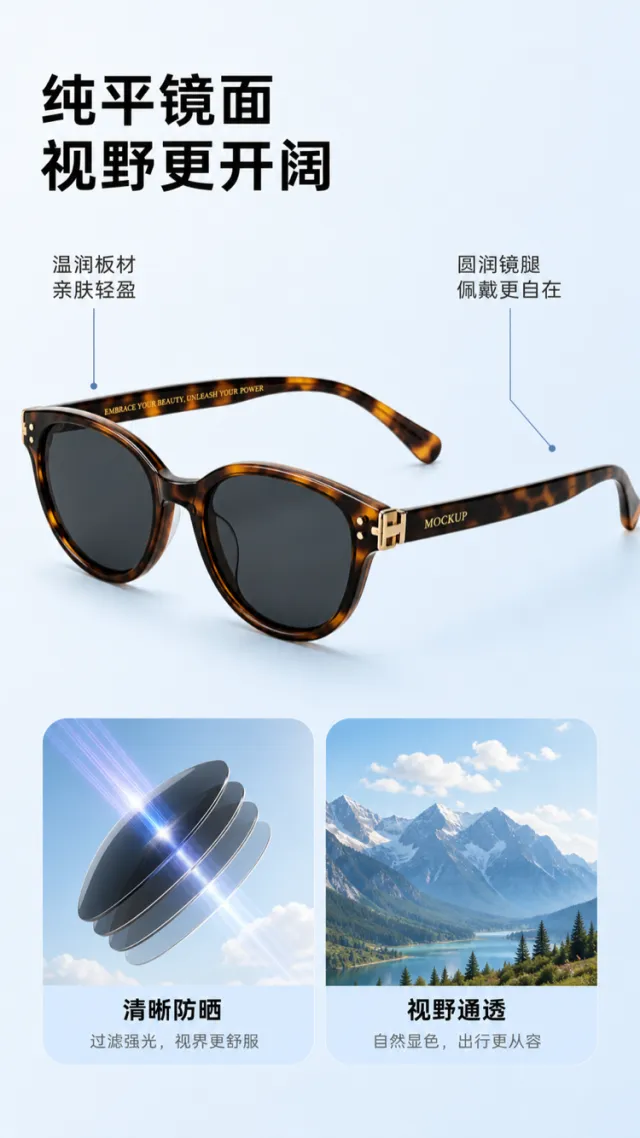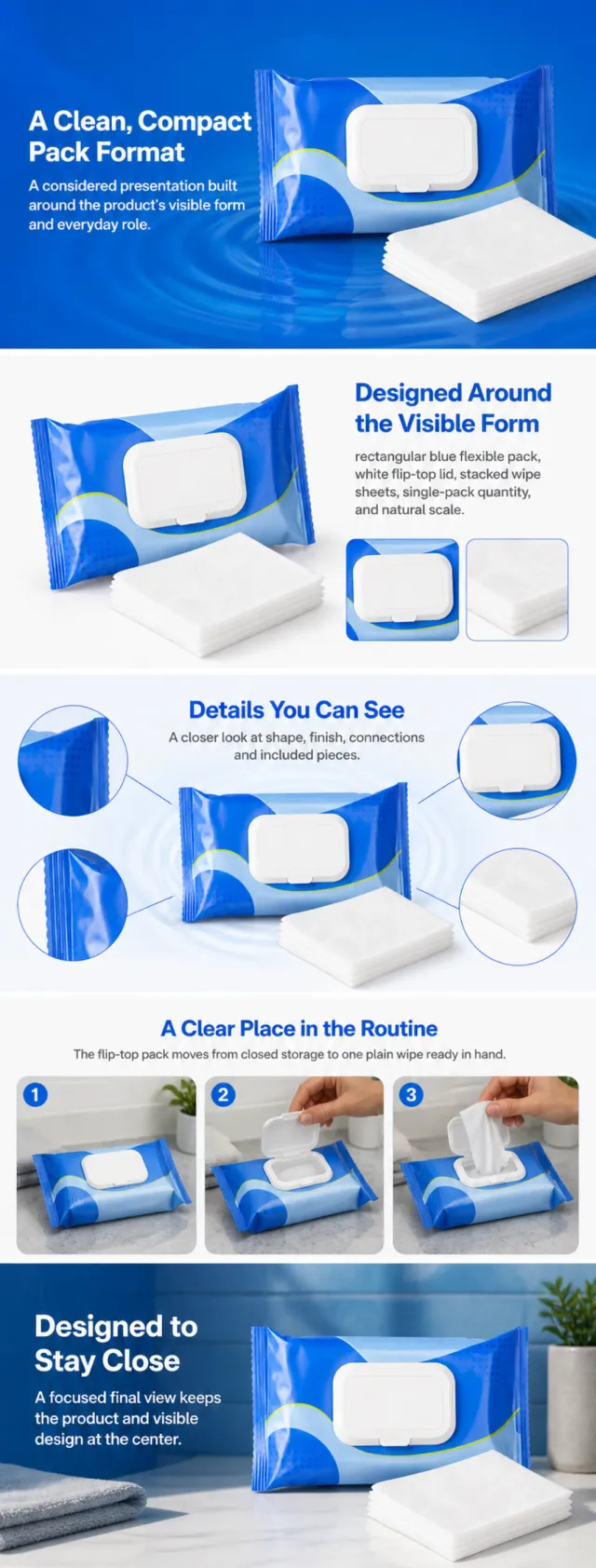
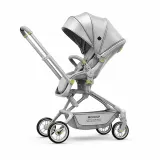
E Commerce Poster Creative Inspiration

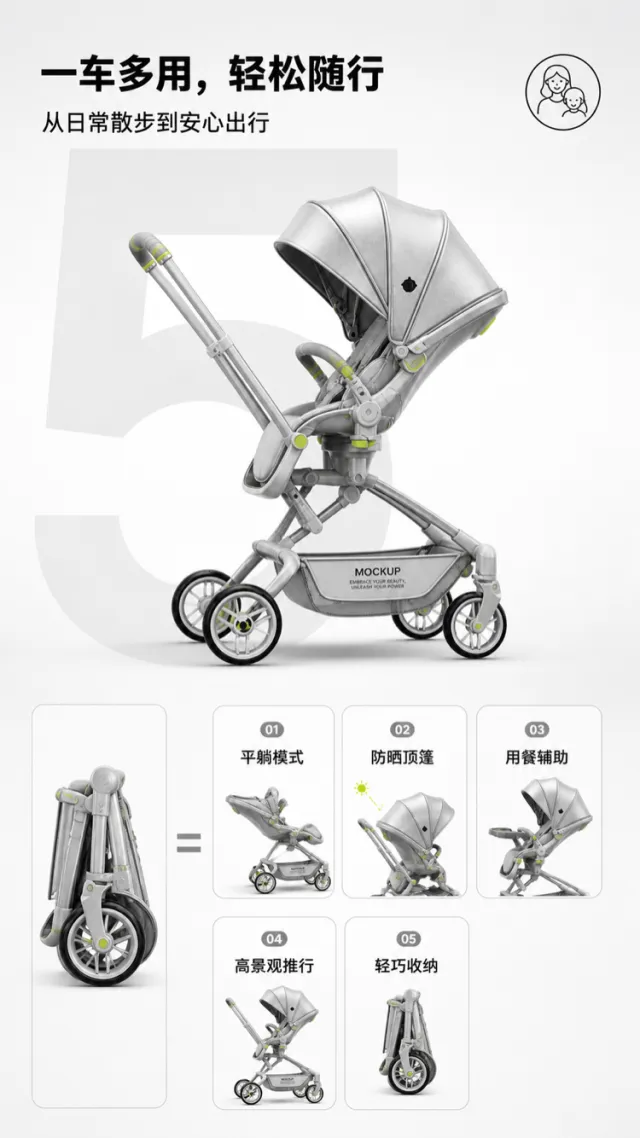
Based on the reference image, generate a multi‑mode stroller e‑commerce product detail page mockup. A silver‑gray stroller is positioned slightly to the side in the upper central area, retaining its push handle, seat, canopy, storage basket, frame, and four wheels. Minor adjustments have been made to the wheel hubs, joints, and light‑green accent details. The product surface displays only “MOCKUP” and “EMBRACE YOUR BEAUTY, UNLEASH YOUR POWER.” The background features a clean gradient from light gray to white, with a large, light‑gray numeral “5” serving as the backdrop beneath the stroller. At the top, centered left, a bold black Chinese headline reads “Multi‑Purpose, Easy On‑the‑Go,” accompanied by the subheading “From Everyday Walks to Peace of Mind Travel.” In the upper right corner, a simple circular parent‑child linear icon is placed. The lower half adopts an equation‑style layout: on the left is a folded stroller, while the right side features five small functional icons labeled, in order, “Flat‑Lying Mode,” “Sun‑Protective Canopy,” “Meal‑Assistance,” “High‑View Pushing,” and “Lightweight Storage.” Each icon is framed in light gray, with soft rounded corners and subtle pictograms. The typography is modern, gentle, and clearly hierarchical; the spacing between icons is uniform, and the design avoids any superfluous brand logos or technical specifications in small print. Output dimensions: 750 x 1334px. Avoid: real brand names, model numbers, footnotes, garbled text, watermarks, overlapping text, text overflow, subject obstruction, distorted subject proportions, duplicate products, low‑resolution icons, and excessive negative space.
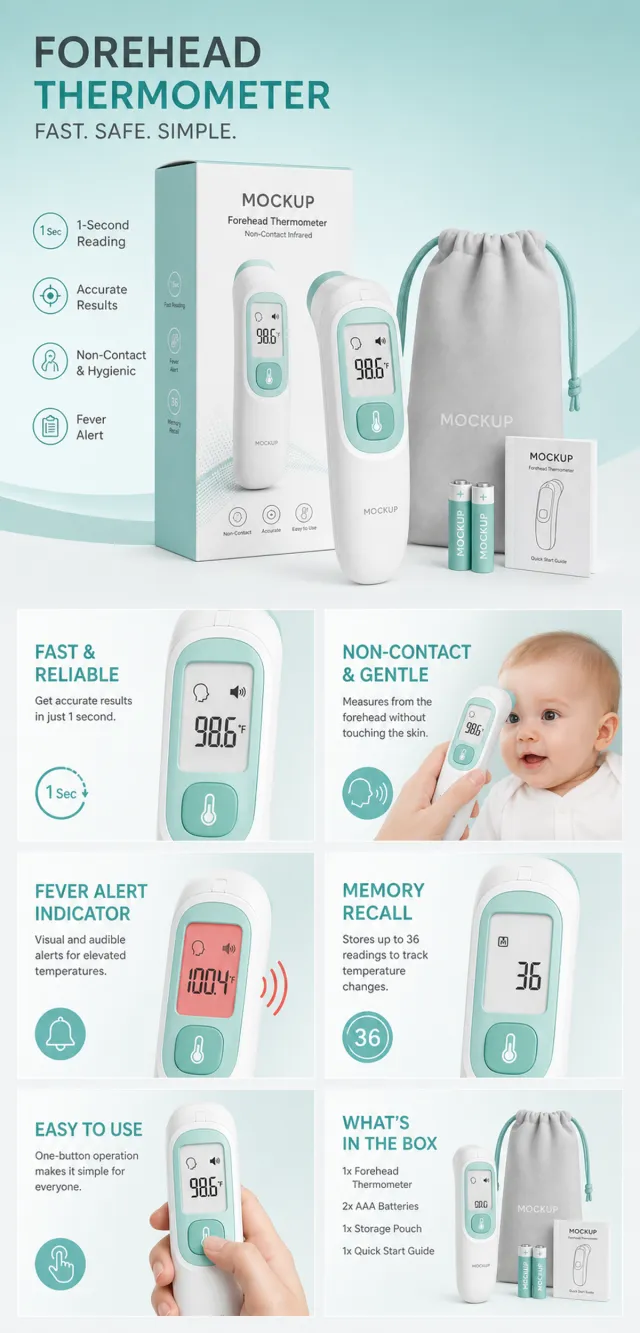
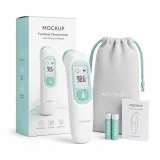
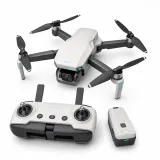
【Execution Routing | Do Not Display】 If the image-generation tool can be invoked multiple times: concatenate the sharing rules with A–F separately, execute six times, generating one 1000×1000 square image each time; do not submit all modules at once. If only one image can be generated per run: set the interface or API to a 2:3 portrait orientation and avoid using Auto mode; a recommended size is 1200×1800. Arrange A/B, C/D, and E/F into a 2-column × 3-row grid of six modules, ensuring equal module sizes and maintaining a 1:1 aspect ratio. If the platform enforces a 1:1 ratio, switch to an Agent-based approach or generate each module individually. 【Sharing Rules】 The provided product reference image serves as the sole product basis. Product: baby care thermometer kit. Copywriting must be in English, with brand placeholders replaced by MOCKUP only. Visuals should follow premium commercial e-commerce photography standards and maintain stable graphic design. The product’s appearance, structure, color, quantity, accessories, and relative proportions must match the reference image; products, people, icons, and props should retain natural proportions. All essential information must remain within the safe zone, with the background extending fully across all four edges. External white borders, vertical sidebars, transparent fill-in areas, watermarks, contact details, social media accounts, platform information, original branding, gibberish, irrelevant content, or unverified claims regarding efficacy or specifications are prohibited. Headlines must not be displayed. A–F must not appear. 【A | Core Selling Point】Write concise English copy focusing on this theme, using the full product main visual to highlight core value. 【B | Usage Instructions】Provide brief English copy addressing this theme, illustrating the usage process, combinations, or key operations. 【C | Applicable Scenarios】Present short English copy centered on this theme, showcasing realistic, credible, and product-relevant usage scenarios. 【D | Functional Details】Offer succinct English copy highlighting structural and functional details through close-up shots, cross-sections, or icons. 【E | Daily Maintenance】Craft brief English copy explaining how to use, clean, store, or maintain the product. 【F | Specification List】Compose concise English copy covering materials, specifications, packaging details, or credible comparisons—avoid fabricating parameters.

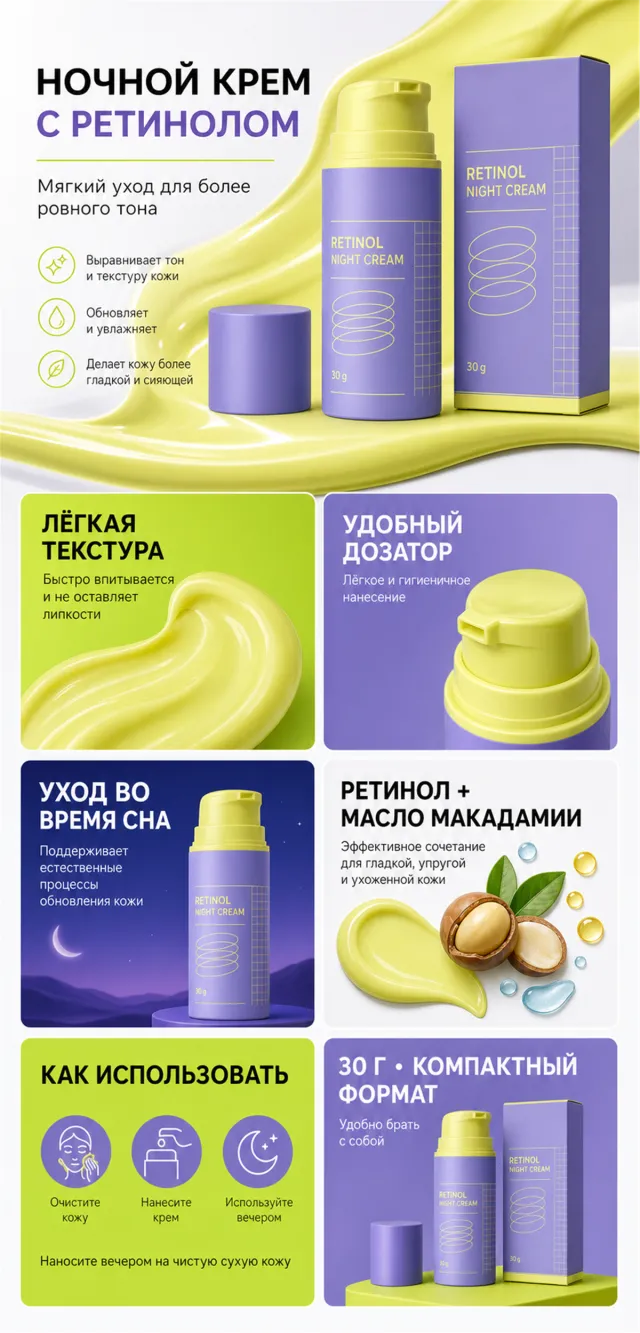
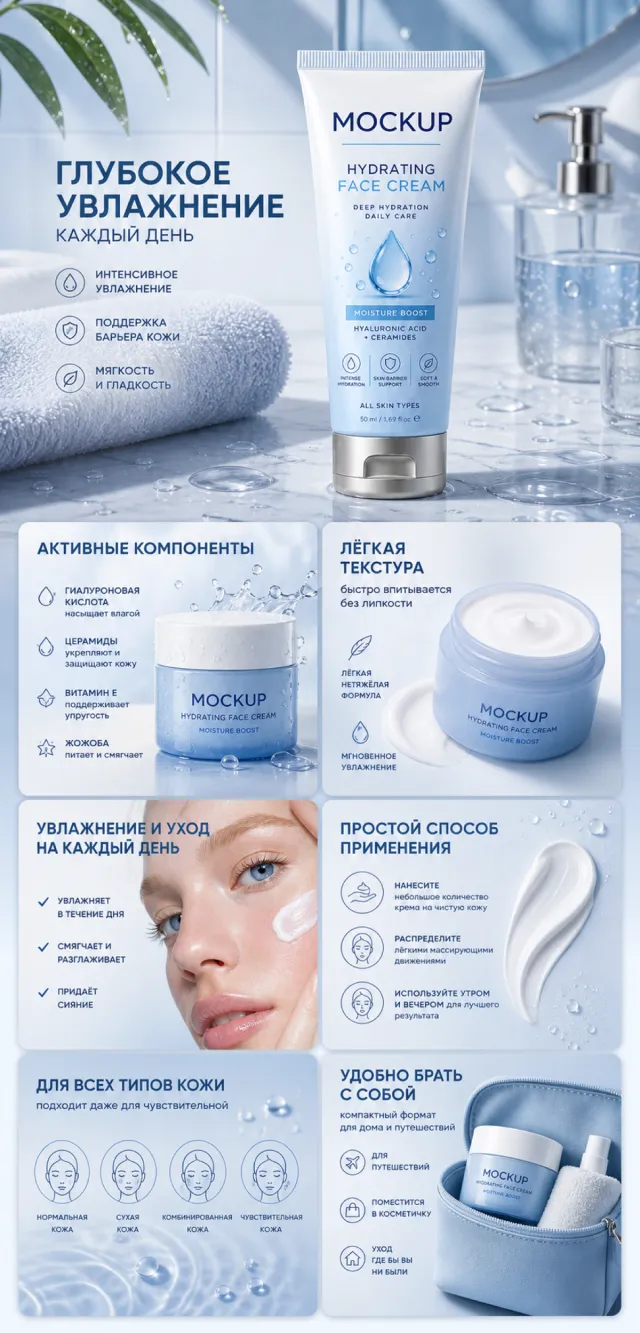
【Execution Routing | Do Not Display】 If the image-generation tool can be invoked multiple times: concatenate the sharing rules with A–F separately, execute six times, generating one 1000×1000 square image each time; do not submit all modules at once. If only one image can be generated per invocation: set the interface or API to a 2:3 portrait orientation and disable Auto mode; a recommended size is 1200×1800. Arrange the images in a 2-column × 3-row grid labeled A/B, C/D, and E/F, ensuring all six modules are equal in size and maintain a 1:1 aspect ratio. If the platform enforces a 1:1 ratio, switch to using an Agent or generate each module individually. 【Sharing Rules】 Use the provided product reference image as the sole basis for the product. Product: retinol night cream. Copywriting should be in Russian, with brand placeholders replaced by MOCKUP only. Visuals must follow high-end commercial e‑commerce photography standards—sharp imagery, clear hierarchy, and concise, easy-to-read copy. The product’s appearance, structure, color, quantity, accessories, and relative proportions must match the reference image; products, people, icons, and props should maintain natural proportions. All essential information must remain within the safe zone, with the background extending fully across all four edges. Avoid white borders, vertical sidebars, transparent fill-in areas, watermarks, contact details, social media accounts, platform information, original branding, gibberish, irrelevant content, or unverified claims regarding efficacy or specifications; titles must not appear. A–F must not be displayed. 【A | Theme】Copy: “The effect of this product is remarkable—its benefits are evident in every detail.” “This product combines advanced technology with gentle care, making it ideal for daily use.” Focus on conveying the core value through the complete main visual of the product. 【B | Theme】Copy: “This product addresses key concerns while delivering exceptional results.” Design an independent square image around this theme, ensuring no overlap in selling points, composition, or product perspective with other modules. 【C | Theme】Copy: “This product delivers powerful results while remaining gentle and effective.” Design an independent square image centered on this theme, avoiding duplication of selling points, compositions, or product angles compared to other modules. 【D | Theme】Copy: “Combining superior care with practicality, this product offers both convenience and effectiveness.” Design an independent square image based on this theme, ensuring no overlap in selling points, composition, or product perspectives with other modules. 【E | Theme】Copy: “This product provides comprehensive care, addressing multiple needs with ease.” Design an independent square image around this theme, avoiding duplication of selling points, compositions, or product angles compared to other modules. 【F | Theme】Copy: “30 days of continuous care—this product delivers remarkable results while being gentle on your skin.” “It helps restore vitality, relieve fatigue, and promote overall well-being, leaving you feeling refreshed and revitalized.” Design an independent square image based on this theme, ensuring no overlap in selling points, compositions, or product angles with other modules.

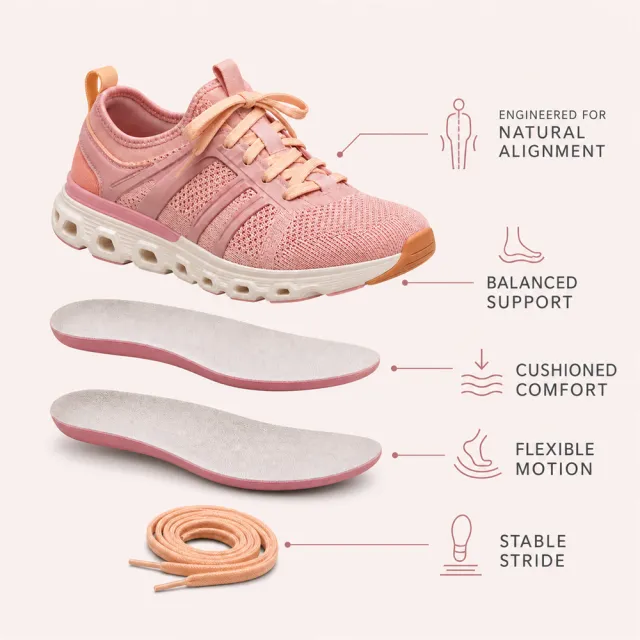
【Output Rules | Do Not Display】 Generate only one 1000×1000, 1:1 Amazon Listing secondary image. No collage images, six-grid layouts, multi-card grids, or multiple scenes are allowed. 【Sharing Rules】 Use the provided product reference image as the sole basis for the product. Product: supportive women's athletic sneaker with removable insoles. Copywriting must be in English; brand placeholders should use MOCKUP only. Visuals must follow high-end commercial e-commerce photography standards—sharp imagery, clear hierarchy, and concise, easy-to-read copy. The product’s appearance, structure, color, quantity, accessories, and relative proportions must match the reference image exactly. Maintain natural proportions among the product, figures, icons, and props. All essential information must remain within the safe area, with the background extending fully to all four edges. Prohibit outer white borders, vertical sidebars, transparent fill-in areas, watermarks, contact details, social media accounts, platform information, original branding, gibberish, irrelevant content, or unverified claims regarding efficacy or specifications. Headlines must not appear. 【Image Composition】 Create a premium pale-blush 1000 x 1000px Amazon infographic using the redesigned product master. Show a vertical exploded view of the shoe, two insole layers, and spare laces with thin leader lines and simple support icons. Use exact copy: "ENGINEERED FOR NATURAL ALIGNMENT", "BALANCED SUPPORT", "CUSHIONED COMFORT", "FLEXIBLE MOTION", "STABLE STRIDE". Keep every item and word within the safe margins.

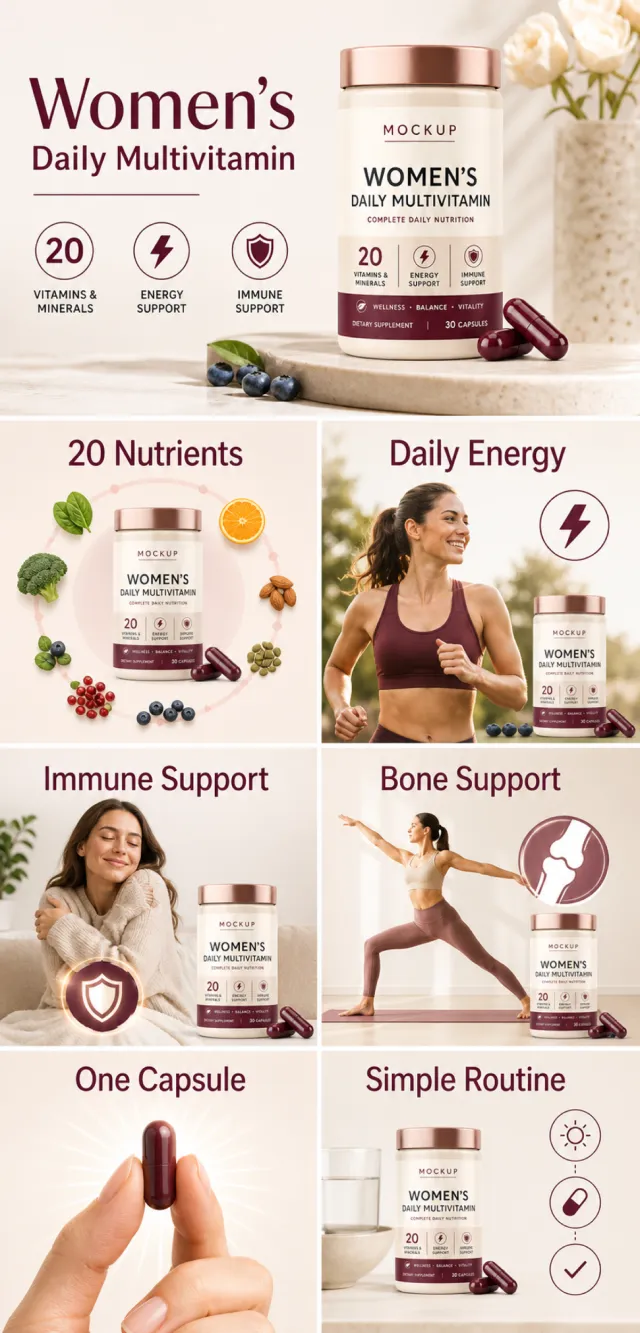
【Execution Routing | Do Not Display】 If the image-generation tool can be invoked multiple times: concatenate the sharing rules with A–F separately, execute six times, generating one 1000×1000 square image each time; do not submit all modules at once. If only one image can be generated per run: set the aspect ratio to 2:3 portrait mode on the interface or via API, and avoid using Auto; a recommended size is 1200×1800. Arrange the modules in a 2-column × 3-row grid labeled A/B, C/D, and E/F, ensuring all six modules are equal in size and maintain a 1:1 proportion. If the platform enforces a 1:1 ratio, switch to an Agent-based approach or generate each module individually. 【Sharing Rules】 The provided product reference image serves as the sole basis for the product. Product: women's daily multivitamin. Copywriting must be in English, and brand placeholders should use MOCKUP only. Visuals should incorporate ivory, burgundy, rose gold, and charcoal. The product’s appearance, structure, colors, quantity, accessories, and relative proportions must match the reference image; product, figures, icons, and props should maintain natural proportions. All essential information must remain within the safe zone, with the background extending fully to all four edges. External white borders, vertical borders on left and right, transparent padding, watermarks, contact details, social media accounts, platform information, original branding, gibberish, irrelevant content, or unverified claims regarding efficacy or specifications are prohibited. Headlines must not be displayed. A–F must not appear. 【A | Theme】Copy: “Women's Daily Multivitamin”; focus on conveying the core value through a complete primary visual centered on the product. 【B | Theme】Copy: “20 Nutrients”; design an independent square image around this theme, ensuring no overlap in selling points, composition, or product angles with other modules. 【C | Theme】Copy: “Daily Energy”; design an independent square image around this theme, avoiding overlaps in selling points, composition, and product angles with other modules. 【D | Theme】Copy: “Immune Support”; design an independent square image around this theme, avoiding overlaps in selling points, composition, and product angles with other modules. 【E | Theme】Copy: “Bone Support”; design an independent square image around this theme, avoiding overlaps in selling points, composition, and product angles with other modules. 【F | Theme】Copy: “One Capsule”; “Simple Routine”; design independent square images around these themes, ensuring no overlap in selling points, composition, or product angles with other modules.

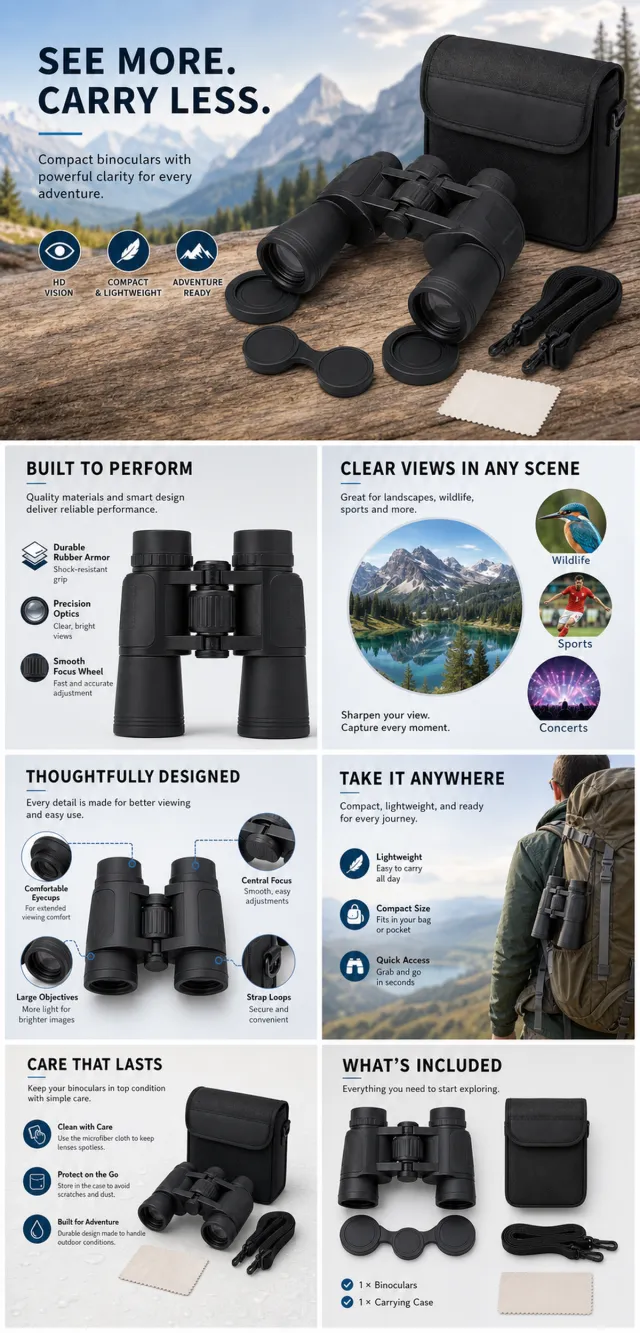
【Execution Route | Do Not Display】 If the image-generation tool can be invoked multiple times: concatenate the sharing rules with A–F separately, execute six times, generating only one 1000×1000 square image per run. If only a single image can be generated at a time: first set the interface/API to a 2:3 portrait orientation (do not use Auto), then arrange A/B, C/D, and E/F into a 2-column × 3-row grid; ensure all six cells are equal in size and maintain a visual aspect ratio of 1:1. The outer canvas must not be 1:1. 【Sharing Rules】 The provided product reference image serves as the sole basis for the product. The product is compact binoculars. Strictly adhere to the reference image’s shape, structure, color, quantity, accessories, texture, and relative proportions; do not fabricate any unseen components, specifications, or functionalities. Use high-quality Amazon commercial photography and clear English infographics, with colors derived from the product itself, realistic lighting, and a clean layout. Maintain natural proportions among the product, figures, hands, icons, and props; stretching, flattening, or independent scaling is prohibited. Titles, products, and labels must remain fully within the safe zone, while the background extends seamlessly across all four edges. Only MOCKUP may be used for branding. External white borders, vertical sidebars, transparent fill-in borders, watermarks, contact information, social media accounts, original brand logos, platform identifiers, garbled text, distorted body parts, or unverified copy are strictly forbidden. A–F are solely control markers and must not be displayed. 【A | Product Overview】Title: “PRODUCT OVERVIEW.” The hero composition fully showcases the product along with the accessories included in the reference image; accompanied by three brief English icon-based selling points, stating only information that is visible or verifiable. 【B | Materials & Design】Title: “MATERIAL & DESIGN.” Present materials, structure, surface finishes, or styling through an overall view of the product combined with 2–3 close-up details; ensure clear labeling without inventing material names. 【C | Functional Focus】Title: “FUNCTION IN FOCUS.” Demonstrate key functions within appropriate usage scenarios; maintain natural proportions among people, hands, and the product, with realistic actions and easily understandable information. 【D | Close-Up Details】Title: “DETAILS UP CLOSE.” Highlight 2–4 critical structural or operational areas using magnified close-ups and short labels; do not alter the product’s structure. 【E | Everyday Use】Title: “MADE FOR REAL LIFE.” Showcase scenes of actual use, carrying, storage, or maintenance that align with the product; retain only one clear theme and avoid duplication with C. 【F | Packaging Contents】Title: “WHAT’S INCLUDED.” Lay out or neatly arrange the actual products and accessories shown in the reference image, ensuring accurate quantities and relative sizes; if the list cannot be confirmed, instead display visible specifications, dimensional relationships, or usage steps—without fabricating numbers.

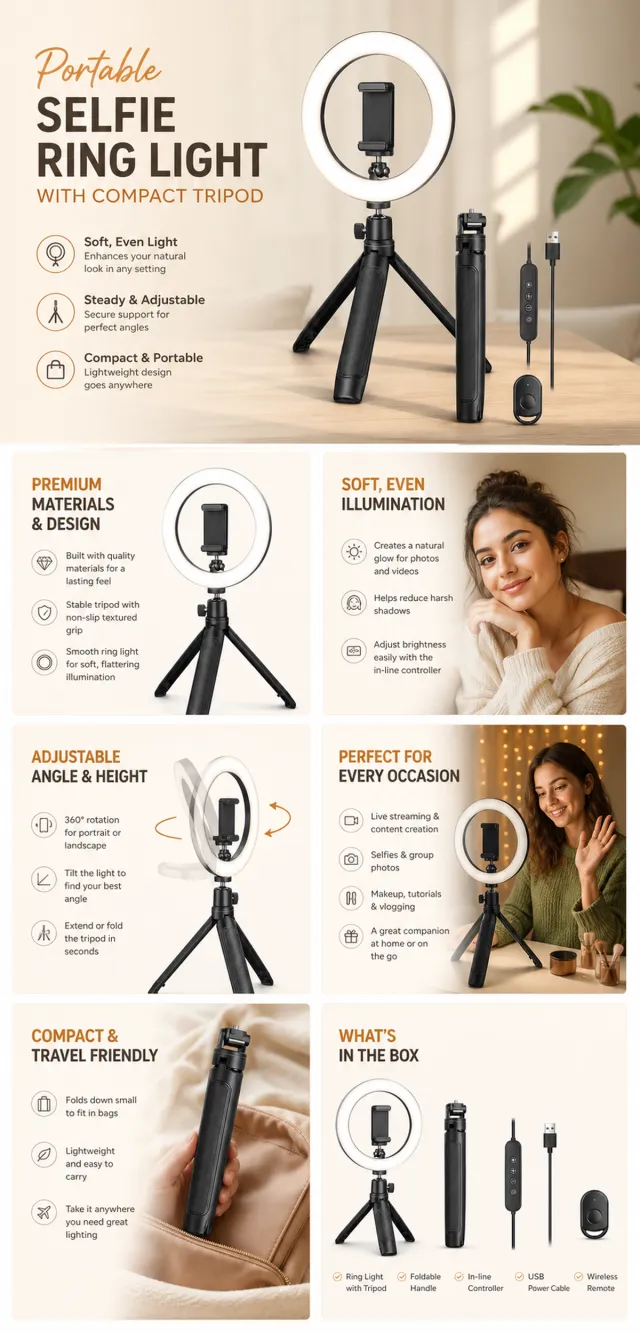
【Execution Route | Do Not Display】 If the image-generation tool can be invoked multiple times: concatenate the sharing rules with A–F separately, execute six times, generating only one 1000×1000 square image each time. If only a single image can be generated at a time: first set the interface/API to a 2:3 portrait orientation (do not use Auto), then arrange A/B, C/D, and E/F into a 2-column × 3-row grid; ensure all six cells are equal in size and maintain a visual aspect ratio of 1:1. The outer canvas must not be 1:1. 【Sharing Rules】 The provided product reference image serves as the sole basis for the product. The product is a portable selfie ring light with a compact tripod. Strictly adhere to the reference image’s shape, structure, color, quantity, accessories, texture, and relative proportions; do not fabricate any unseen components, specifications, or functions. Use high-quality Amazon commercial photography and clear English infographics; color schemes should match the product, lighting must be realistic, and layout kept simple. Maintain natural proportions among the product, human subjects, hands, icons, and props—no stretching, flattening, or independent scaling is allowed. Titles, products, and labels must remain fully within the safe zone, while the background extends across the entire frame on all four sides. Only MOCKUP may be used for branding. No white borders, vertical edges on either side, transparent fill-in borders, watermarks, contact information, social media accounts, original brand logos, platform identifiers, garbled text, distorted body parts, or unverified copywriting are permitted. A–F are solely control markers and must not be displayed. 【A | Product Overview】Title: “PRODUCT OVERVIEW.” The hero composition fully showcases the product along with the accessories depicted in the reference image; include three brief English icon-based selling points, stating only information that is visible or verifiable. 【B | Materials & Design】Title: “MATERIAL & DESIGN.” Present materials, structure, surface finish, or styling through an overall view of the product combined with 2–3 close-up details; ensure clear labeling without inventing material names. 【C | Function in Focus】Title: “FUNCTION IN FOCUS.” Demonstrate key functions within realistic usage scenarios; maintain natural proportions between people, hands, and the product, with authentic gestures and easily understandable information. 【D | Details Up Close】Title: “DETAILS UP CLOSE.” Highlight 2–4 critical structural or operational areas using magnified details and short captions; do not alter the product’s structure. 【E | Everyday Use】Title: “MADE FOR REAL LIFE.” Depict usage, portability, storage, or maintenance scenarios consistent with the product; retain only one clear theme and avoid duplication with C. 【F | Packaging Contents】Title: “WHAT’S INCLUDED.” Lay out or neatly arrange the actual products and accessories shown in the reference image, ensuring accurate quantities and relative sizes; if the contents cannot be confirmed, instead display visible specifications, dimensional relationships, or usage steps without fabricating numbers.

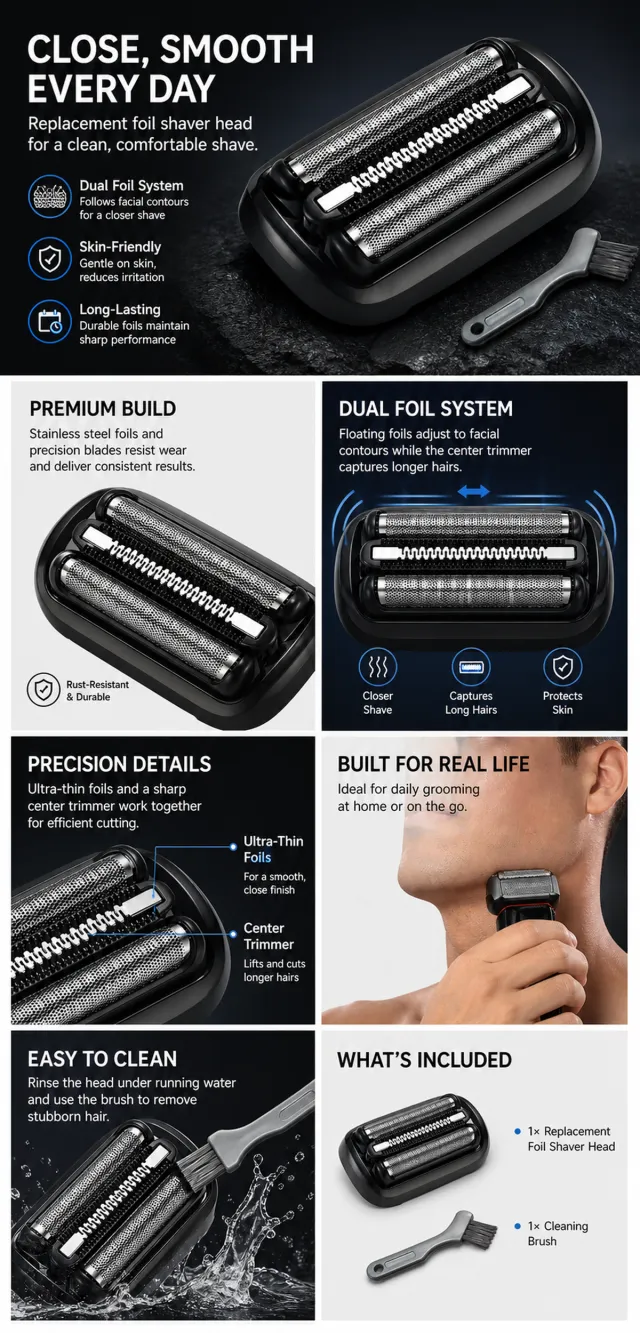
【Execution Route | Do Not Display】 If the image-generation tool can be invoked multiple times: concatenate the sharing rules with A–F separately, execute six times, generating only one 1000×1000 square image per run. If only a single image can be generated at a time: first set the interface/API to a 2:3 portrait orientation (do not use Auto), then arrange A/B, C/D, and E/F into a 2-column × 3-row grid; ensure all six cells are equal in size and maintain a visual aspect ratio of 1:1. The outer canvas must not be 1:1. 【Sharing Rules】 The provided product reference image serves as the sole basis for the product. The product is a replacement foil shaver head and cleaning brush. Strictly adhere to the reference image’s shape, structure, color, quantity, included accessories, texture, and relative proportions; do not fabricate any unseen components, specifications, or functions. Use high-quality Amazon commercial photography and clear English infographics, with colors derived from the product itself, realistic lighting, and a clean layout. Maintain natural proportions for the product, figures, hands, icons, and props—no stretching, flattening, or independent scaling is allowed. Titles, products, and labels must remain fully within the safe zone, while the background extends seamlessly across all four edges. Only use MOCKUP for branding. No white borders, vertical sidebars, transparent fill‑ins, watermarks, contact information, social media accounts, original brand logos, platform identifiers, garbled text, distorted body parts, or unverified copywriting are permitted. A–F are solely control markers and must not be displayed. 【A | Product Overview】Title: “PRODUCT OVERVIEW.” The hero composition should fully showcase the product along with the accessories depicted in the reference image, accompanied by three brief English icon‑based selling points that highlight only visible or verifiable information. 【B | Materials & Design】Title: “MATERIAL & DESIGN.” Present materials, structure, surface finishes, or styling through an overall view of the product combined with 2–3 close-up details; ensure clear labeling without inventing material names. 【C | Function in Focus】Title: “FUNCTION IN FOCUS.” Demonstrate key functions within realistic usage scenarios; maintain natural proportions among characters, hands, and the product, with authentic gestures and easily understandable information. 【D | Details Up Close】Title: “DETAILS UP CLOSE.” Highlight 2–4 critical structural or operational areas using magnified details and short captions; do not alter the product’s underlying structure. 【E | Everyday Use】Title: “MADE FOR REAL LIFE.” Depict usage, portability, storage, or maintenance scenarios consistent with the product; retain only one clear theme and avoid duplication with C. 【F | Packaging Contents】Title: “WHAT’S INCLUDED.” Lay out or neatly arrange the actual products and accessories shown in the reference image, ensuring accurate quantities and relative sizes; if the contents cannot be confirmed, instead display visible specifications, dimensional relationships, or step-by-step instructions, without fabricating numbers.

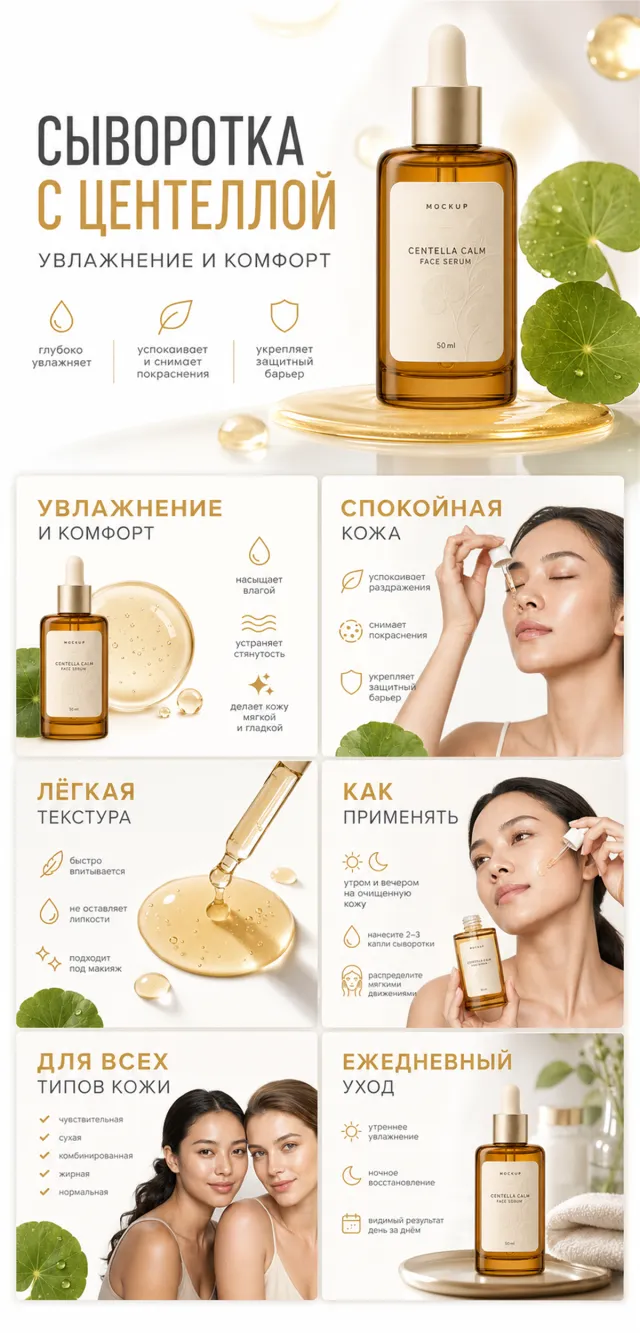
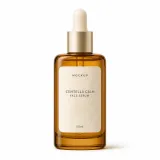
【Execution Routing | Do Not Display】 If the image-generation tool can be invoked multiple times: concatenate the sharing rules with A–F separately, execute six times, generating one 1000×1000 square image each time; do not submit all modules at once. If only one image can be generated per run: set the interface or API to a 2:3 portrait orientation and disable Auto mode; a recommended size is 1200×1800. Arrange the images in a 2-column × 3-row grid corresponding to A/B, C/D, and E/F, ensuring all six modules are equal in size and maintain a 1:1 aspect ratio. If the platform enforces a 1:1 ratio, switch to using an Agent or generate each module individually. 【Sharing Rules】 The provided product reference image serves as the sole basis for the product. Product: Centella Calming Face Serum. Copywriting should be in Russian, with brand placeholders replaced by MOCKUP only. Visuals must follow high-end commercial e‑commerce photography standards—sharp imagery, clear hierarchy, and concise, easy-to-read copy. The product’s appearance, structure, color, quantity, accessories, and relative proportions must match the reference image; products, people, icons, and props should maintain natural proportions. All essential information must remain within the safe zone, with the background extending fully across all four edges. External white borders, vertical borders on left and right, transparent fill-in borders, watermarks, contact details, social media accounts, platform information, original branding, gibberish, irrelevant content, or unverified claims regarding efficacy or specifications are prohibited. Headlines must not be displayed. A–F must not appear. 【A | Theme】Copy: “CENTELLA SERUM”; “MOISTURIZATION AND COMFORT”—focus on conveying the core value through the complete primary visual of the product. 【B | Theme】Copy: “CALM SKIN”—design an independent square image around this theme, ensuring no overlap in selling points, composition, or product angles with other modules. 【C | Theme】Copy: “LIGHT TEXTURE”—design an independent square image around this theme, avoiding repetition of selling points, composition, and product angles compared to other modules. 【D | Theme】Copy: “HOW TO USE”—design an independent square image around this theme, ensuring no overlap in selling points, composition, or product angles with other modules. 【E | Theme】Copy: “FOR ALL SKIN TYPES”—design an independent square image around this theme, avoiding repetition of selling points, composition, and product angles with other modules. 【F | Theme】Copy: “DAILY CARE”—design an independent square image around this theme, avoiding repetition of selling points, composition, and product angles with other modules.

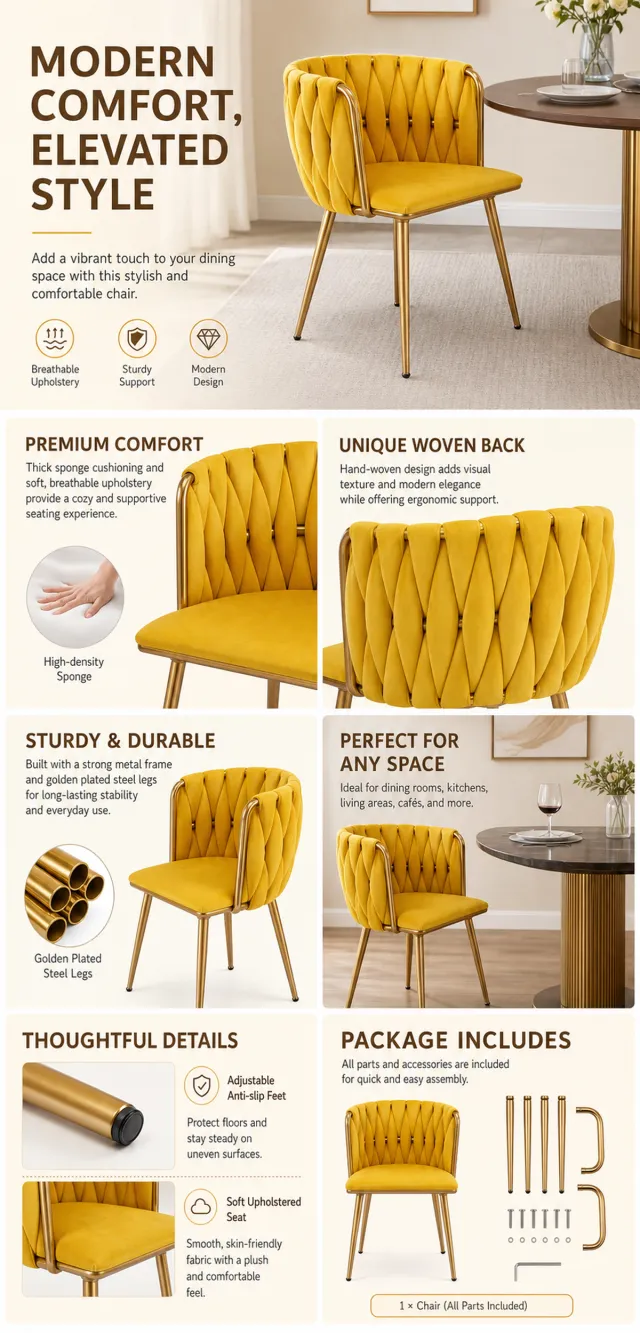
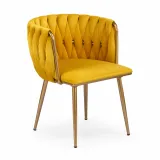
【Execution Route | Do Not Display】 If the image-generation tool can be invoked multiple times: concatenate the sharing rules with A–F separately, execute six times, generating only one 1000×1000 square image each time. If only a single image can be generated at a time: first set the interface/API to a 2:3 portrait orientation (do not use Auto), then arrange A/B, C/D, and E/F into a 2-column × 3-row grid; ensure all six cells are equal in size and maintain a visual aspect ratio of 1:1. The outer canvas must not be 1:1. 【Sharing Rules】 The provided product reference image serves as the sole basis for the product. The product is a mustard upholstered dining chair. Strictly adhere to the reference image’s shape, structure, color, quantity, accessories, texture, and relative proportions; do not fabricate any components, specifications, or functions that are not shown. Use high-quality Amazon commercial photography and clear English infographics; color schemes should match the product, lighting should be realistic, and layout should be simple. Maintain natural proportions among the product, figures, hands, icons, and props—no stretching, flattening, or independent scaling is allowed. Titles, products, and labels must remain entirely within the safe zone, with the background extending fully to all four edges. Only use MOCKUP for branding. No white borders, vertical sidebars, transparent fill‑ins, watermarks, contact information, social media accounts, original brand logos, platform identifiers, garbled text, distorted body parts, or unverified copywriting are permitted. A–F are solely control markers and must not be displayed. 【A | Product Overview】Title: “PRODUCT OVERVIEW.” The hero composition fully showcases the product along with the accessories included in the reference image; accompanied by three brief English icon-based selling points, stating only information that is visible or verifiable. 【B | Materials & Design】Title: “MATERIAL & DESIGN.” Present materials, structure, surface finishes, or styling through an overall view of the product combined with 2–3 close-up details; ensure clear annotations without fabricating material names. 【C | Functional Focus】Title: “FUNCTION IN FOCUS.” Demonstrate key functions within realistic usage scenarios; maintain natural proportions among figures, hands, and the product, with actions appearing genuine and information easily understandable at a glance. 【D | Detail Close-Ups】Title: “DETAILS UP CLOSE.” Highlight 2–4 critical structural or operational areas using magnified details and short captions; do not alter the product’s structure. 【E | Everyday Use】Title: “MADE FOR REAL LIFE.” Showcase usage, portability, storage, or maintenance scenarios consistent with the product; retain only one clear theme and avoid redundancy with C. 【F | Packing List】Title: “WHAT’S INCLUDED.” Lay out or neatly arrange the actual products and accessories featured in the reference image, ensuring accurate quantities and relative sizes; if the list cannot be confirmed, instead display visible specifications, dimensional relationships, or usage steps without inventing numbers.

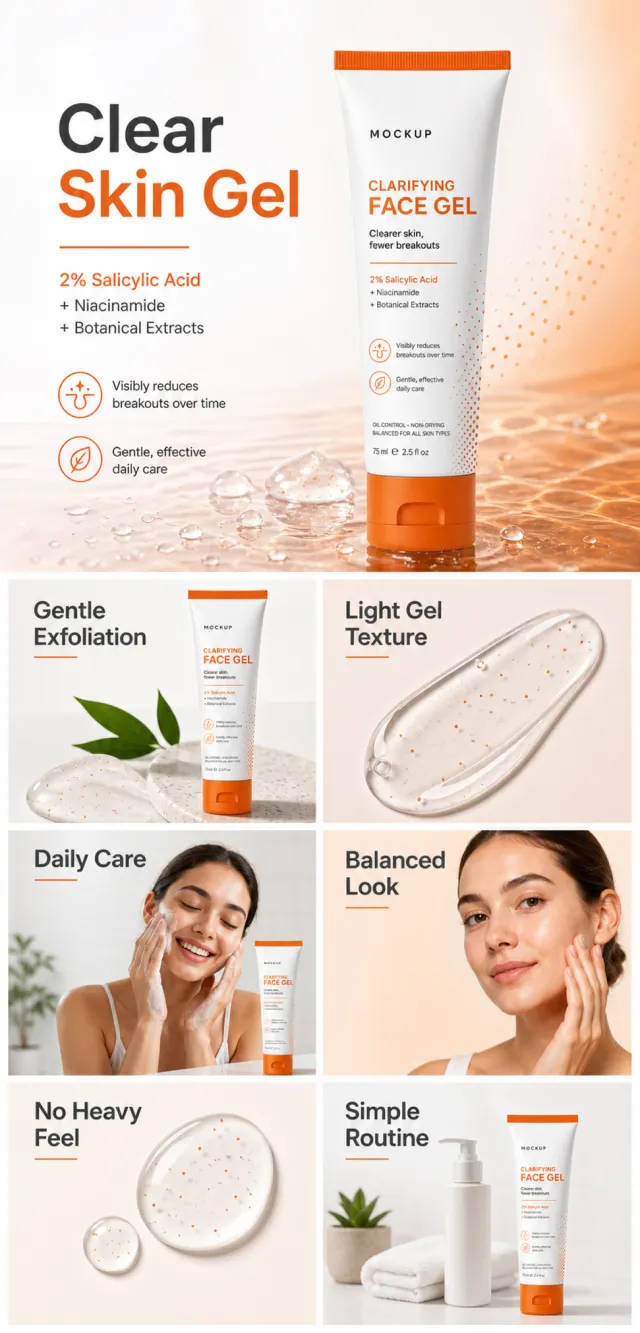
【Execution Routing | Do Not Display】 If the image-generation tool can be invoked multiple times: concatenate the sharing rules with A–F separately, execute six times, generating one 1000×1000 square image each time; do not submit all modules at once. If only one image can be generated per run: set the interface or API to a 2:3 portrait orientation and disable Auto mode; a recommended size is 1200×1800. Arrange A/B, C/D, and E/F into a 2-column × 3-row grid of six modules, ensuring equal module sizes and maintaining a 1:1 aspect ratio. If the platform enforces a 1:1 ratio, switch to using an Agent or generate each module individually. 【Sharing Rules】 The provided product reference image serves as the sole basis for the product. Product: clarifying face gel. Copywriting must be in English, with brand placeholders replaced by MOCKUP only. Visuals should incorporate white, burnt orange, peach, and charcoal. The product’s appearance, structure, color, quantity, accessories, and relative proportions must match the reference image; products, figures, icons, and props must maintain natural proportions. All essential information must remain within the safe zone, with the background extending fully to all four edges. External white borders, vertical borders on left and right, transparent fill-in borders, watermarks, contact details, social media accounts, platform information, original branding, gibberish, irrelevant content, or unverified claims regarding efficacy or specifications are prohibited. Headlines must not be displayed. A–F must not appear. 【A | Theme】Copy: “Clear Skin Gel”; use the full product main visual to prominently convey its core value. 【B | Theme】Copy: “Gentle Exfoliation”; design an independent square image around this theme, ensuring it avoids duplicating selling points, compositions, or product angles with other modules. 【C | Theme】Copy: “Light Gel Texture”; design an independent square image centered on this theme, avoiding overlap in selling points, composition, and product perspective with other modules. 【D | Theme】Copy: “Daily Care”; create an independent square image based on this theme, while preventing repetition of selling points, composition, and product angles compared to other modules. 【E | Theme】Copy: “Balanced Look”; develop an independent square image revolving around this theme, ensuring no duplication of selling points, composition, or product angles with other modules. 【F | Theme】Copy: “No Heavy Feel” and “Simple Routine”; design separate square images for these themes, avoiding overlap in selling points, composition, and product angles with other modules.

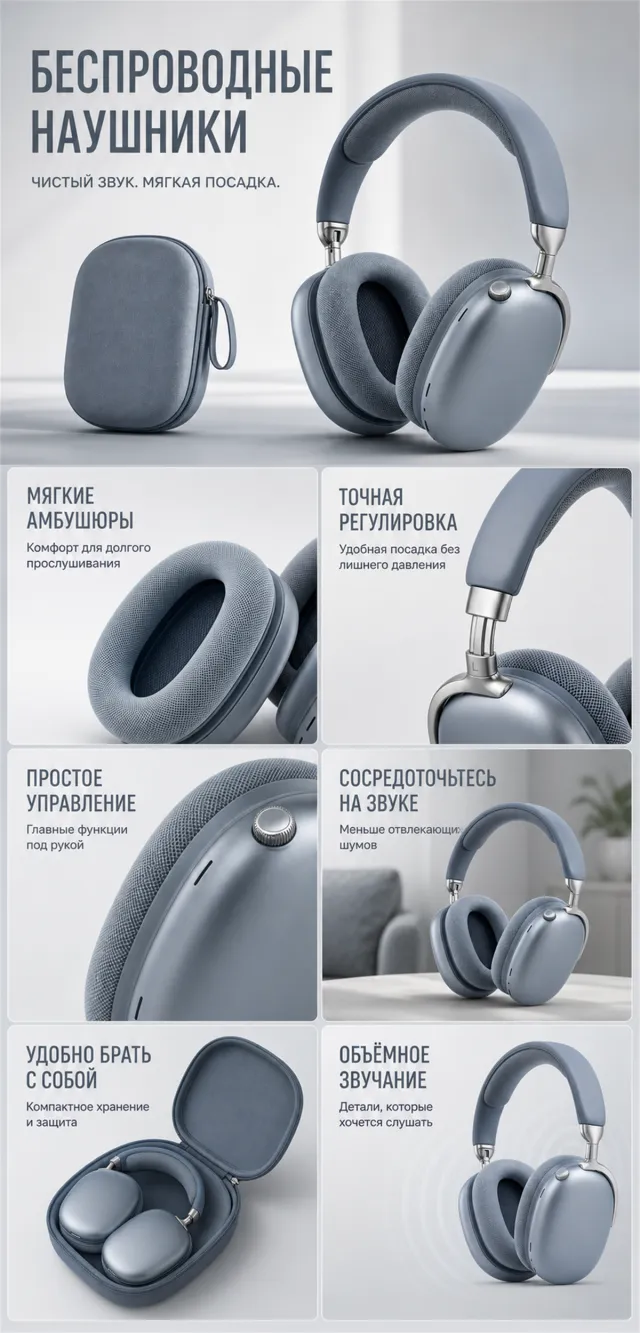
【Execution Routing | Do Not Display】 If the image-generation tool can be invoked multiple times: concatenate the sharing rules with A–F separately, execute six times, generating one 1000×1000 square image each time; do not submit all modules at once. If only one image can be generated per invocation: set the interface or API to a 2:3 portrait orientation and disable Auto mode; a recommended size is 1200×1800. Arrange A/B, C/D, and E/F into a 2-column × 3-row grid of six modules, ensuring equal module sizes and maintaining a 1:1 aspect ratio. If the platform enforces a 1:1 ratio, switch to using an Agent or generate each module individually. 【Sharing Rules】 The provided product reference image serves as the sole product basis. Product: premium wireless over-ear headphones with travel case. Copywriting should be in Russian, with brand placeholders replaced by MOCKUP only. Visuals must employ high‑end commercial e‑commerce photography—sharp imagery, clear hierarchy, and concise, easy‑to‑read copy. The product’s appearance, structure, color, quantity, accessories, and relative proportions must match the reference image; products, people, icons, and props should maintain natural proportions. All essential information must remain within the safe zone, with the background extending fully across all four edges. External white borders, vertical borders on left and right, transparent fill‑ins, watermarks, contact details, social media accounts, platform information, original branding, garbled text, irrelevant content, or unverified claims regarding efficacy or specifications are prohibited; titles must not be displayed. A–F must not appear. 【A | Core Selling Point】Write brief Russian copy that succinctly conveys this theme, focusing on the core value through the full‑frame main visual. 【B | Usage Instructions】Provide concise Russian copy addressing this theme, illustrating the usage workflow, compositional relationships, or key operations. 【C | Applicable Scenarios】Craft brief Russian copy highlighting this theme, showcasing realistic, credible, and product‑related use cases. 【D | Functional Details】Offer short Russian copy explaining structural and functional details via close‑up shots, cross‑sections, or icons. 【E | Daily Maintenance】Present brief Russian copy covering methods for use, cleaning, storage, or maintenance. 【F | Specification List】Compose concise Russian copy detailing materials, specifications, packaging contents, or credible comparisons—without fabricating parameters.

【Execution Route | Must Not Appear on Screen】 If the image-generation tool can be invoked multiple times: concatenate the sharing rules with A–F separately and execute six times; each time, generate only one independent 1000×1000 square image, resulting in six sub‑images. If single‑shot generation is permitted: use a 2:3 vertical canvas measuring 1200×2500, with the top approximately 30% reserved for the product’s main visual integrated into the background, and arrange the remaining area into a 2‑column × 3‑row grid labeled A/B, C/D, and E/F. All six cards should be equal in size, with visual proportions close to 1:1. Do not use an outer 1:1 canvas, nor full‑width cards, cross‑column cards, merged cards, borders, frames, or white margins. 【Sharing Rules】 The provided product reference image serves as the sole basis for the product’s appearance, structure, color, quantity, accessories, and relative proportions. Product orientation: light blue household vacuum cleaner—main unit, nozzle, hose, and accessories; multi‑surface cleaning, dustbin, filtration, and storage. The product itself, along with any newly generated characters, animals, props, or text, must maintain natural proportions; stretching, flattening, or non‑uniform scaling is prohibited. The background should extend fully across all four edges. Branding must uniformly follow the MOCKUP style; remove original branding, logos, watermarks, contact information, social media accounts, platform details, gibberish, and irrelevant content. Copywriting should be concise, clear, and credible, maintaining the language of the reference image, without adding unsubstantiated absolute claims or medical promises. A–F are merely control markers and must not appear on screen. 【A | Core Selling Point】 Highlight the product’s most important value and its complete main body; keep the headline short and clear. 【B | Structure and Materials】 Showcase key structural elements, materials, or components through close-up shots or simple annotations, adhering to the product’s intended direction. 【C | Real‑World Use】 Generate natural human/animal figures or everyday scenes to demonstrate realistic usage, ensuring proportions and actions appear believable. 【D | Details and Steps】 Use close‑ups, step‑by‑step instructions, or flowcharts to explain operations, textures, interfaces, storage solutions, or maintenance details. 【E | Lifestyle】 Illustrate how the product seamlessly integrates into daily life scenarios such as home, commuting, outdoor activities, travel, or work. 【F | Sets and Portability】 Accurately depict the product, its accessories, quantities, and storage relationships; do not add any components absent from the reference image.

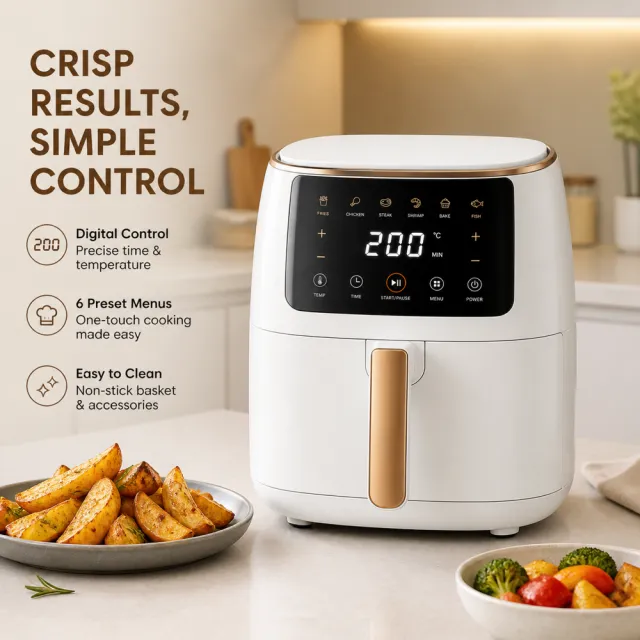
【Output Guidelines | Must Not Appear in the Image】 Generate only one final 1000×1000, 1:1 Amazon Listing secondary image. Do not use collage, six‑panel grids, storyboards, multi‑card grids, split‑screen layouts, or second images. 【Sharing Guidelines】 Use the provided product reference image as the sole basis for depicting the product’s appearance, structure, color, quantity, accessories, and relative proportions. Product orientation: white air fryer with digital display and preset menus; kitchen setting, digital controls, cooking functionality, and easy cleaning. Ensure the product is fully presented, with all subjects, props, and text maintaining natural proportions—no stretching, flattening, cropping, or independent non‑proportional scaling. Extend the background to fill the entire frame on all four sides. Use MOCKUP consistently across all branding; remove original brand elements, logos, watermarks, contact information, social media accounts, platform details, gibberish, and any irrelevant content. Keep copy concise, clear, and credible, adhering to the language of the reference image, and refrain from adding unsubstantiated absolute claims or medical promises. Create new, natural human or animal figures—do not replicate characters from the original image. 【Image Composition】 Produce a single, complete, single‑scene product secondary image: place the product at the visual center, integrate it with a natural lifestyle scene that aligns with the product’s intended use, preserve all product information and maintain safe margins, ensure harmonious blending between background and subject, and avoid white borders, vertical edges on either side, outer frames, or visible collage boundaries.

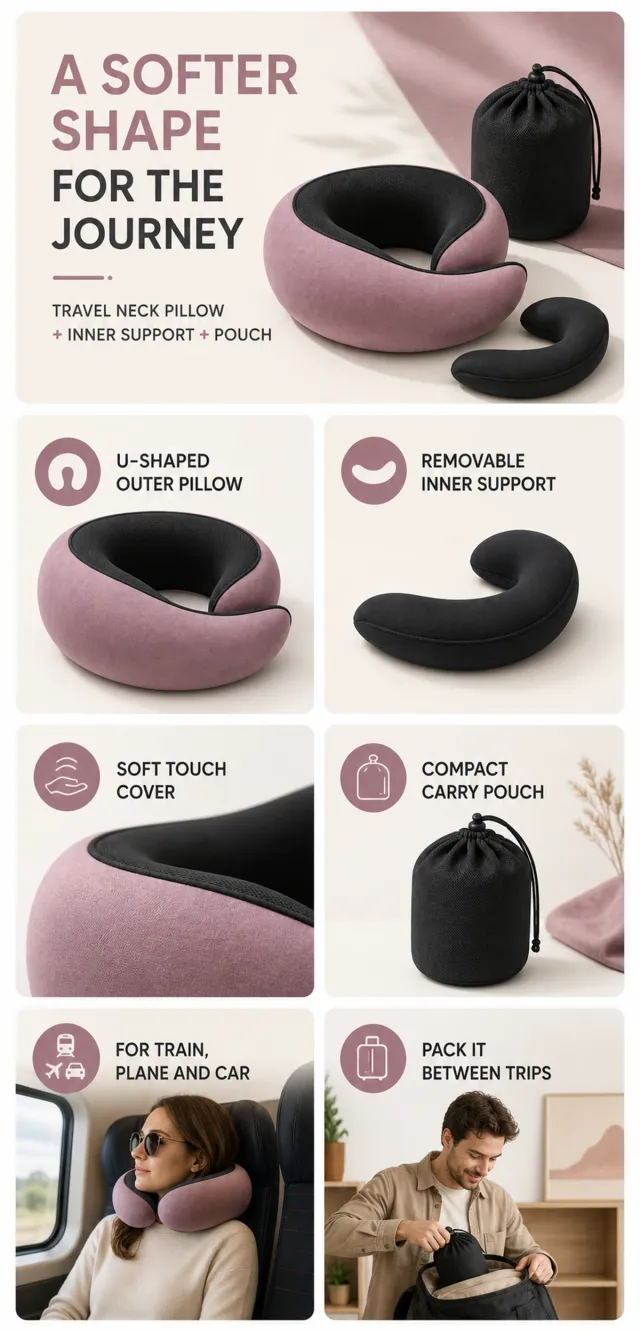
【Execution Routing | Do Not Display】 If the image-generation tool can be invoked multiple times: concatenate the sharing rules with A–F separately, execute six times, generating one 1000×1000 square image each time; do not submit all modules at once. If only one image can be generated per invocation: set the aspect ratio to 2:3 vertical in the interface or via API, and avoid using Auto mode; a recommended size is 1200×1800. Arrange the images into a 2-column × 3-row grid labeled A/B, C/D, and E/F, ensuring all six modules are equal in size and maintain a 1:1 proportion. If the platform enforces a 1:1 ratio, switch to an Agent-based approach or generate each module individually. 【Sharing Rules】 Use the provided product reference image as the sole product basis. Product: travel neck pillow set. Copywriting must be in English, with brand placeholders replaced by MOCKUP only. Visuals should follow high-end commercial e-commerce photography standards—sharp imagery, clear hierarchy, and concise, easy-to-read copy. The product’s appearance, structure, color, quantity, accessories, and relative proportions must match the reference image; products, people, icons, and props should maintain natural proportions. All essential information must remain within the safe zone, with the background extending fully across all four edges. Avoid white borders, vertical sidebars, transparent fill-in areas, watermarks, contact details, social media accounts, platform information, original branding, garbled text, irrelevant content, or unverified claims regarding efficacy or specifications; titles must not be displayed. A–F must not appear. 【A|Theme】Copy: “A SOFTER SHAPE FOR THE JOURNEY”; “TRAVEL NECK PILLOW + INNER SUPPORT + POUCH.” Focus on conveying core value through a complete product-centric visual. 【B|Theme】Copy: “U-SHAPED OUTER PILLOW.” Design an independent square image around this theme, ensuring no overlap in selling points, composition, or product angles with other modules. 【C|Theme】Copy: “REMOVABLE INNER SUPPORT.” Design an independent square image around this theme, avoiding duplication of selling points, composition, or product angles with other modules. 【D|Theme】Copy: “SOFT TOUCH COVER.” Design an independent square image around this theme, ensuring no overlap in selling points, composition, or product angles with other modules. 【E|Theme】Copy: “COMPACT CARRY POUCH.” Design an independent square image around this theme, avoiding duplication of selling points, composition, or product angles with other modules. 【F|Theme】Copy: “FOR TRAIN, PLANE AND CAR”; “PACK IT BETWEEN TRIPS.” Design an independent square image around this theme, ensuring no overlap in selling points, composition, or product angles with other modules.

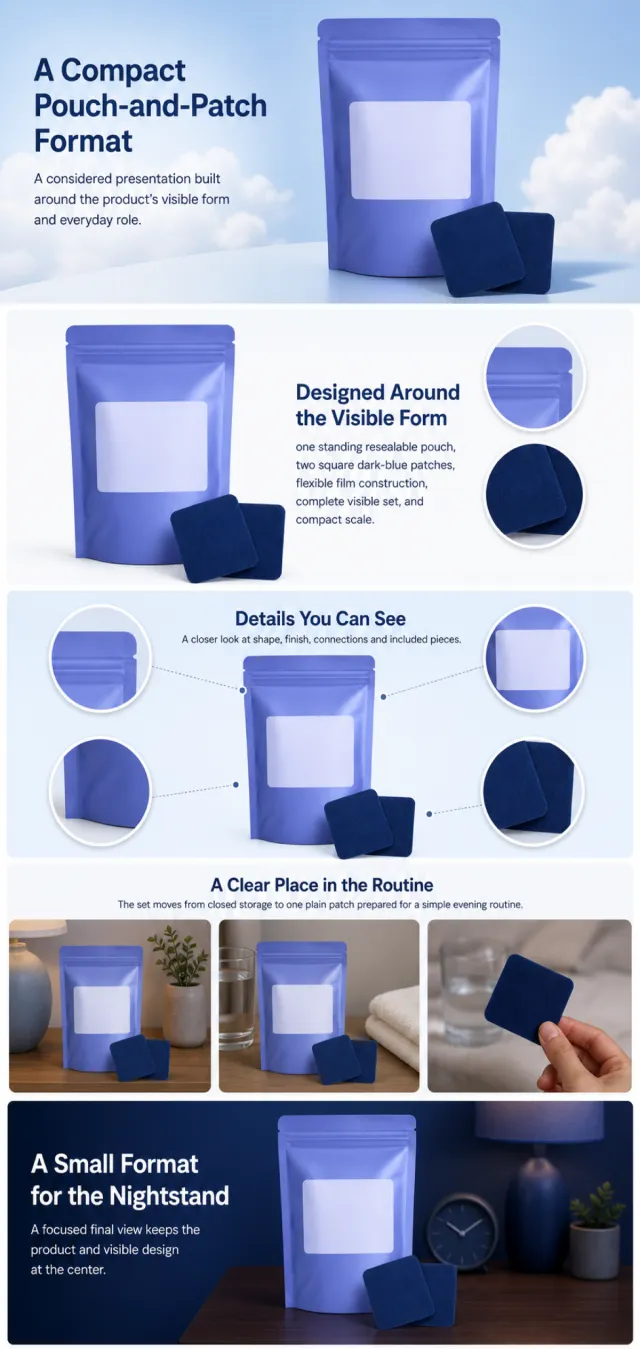
Using the supplied reference image as the sole product reference, create an Amazon A+ design preview for a pouch-and-patch personal-care set. Preserve exact geometry, proportions, colors, construction, quantity, accessories, and scale. Visible details: one standing resealable pouch, two square dark-blue patches, flexible film construction, complete visible set, and compact scale. Do not invent hidden parts or claims. Visual system: periwinkle blue, deep navy, white, and pale cloud blue. Composition motifs: soft cloud fields, rounded instruction panels, circular placement crops, and botanical still lifes. Alternate a wide banner, asymmetric overview, centered detail graphic, three-scene sequence, and wide closing scene. Use readable sans-serif type and mobile-safe margins. Build this official A+ module order. Keep every module independently complete; never split copy or product details. MODULE 1 — Image with text overlay — introduction Exact headline: “A Compact Pouch-and-Patch Format” Exact supporting copy: “A considered presentation built around the product’s visible form and everyday role.” Layout: wide image-led hero; dominant complete product and large safe headline area. MODULE 2 — Single image with side text — product overview Exact headline: “Designed Around the Visible Form” Exact supporting copy: “one standing resealable pouch, two square dark-blue patches, flexible film construction, complete visible set, and compact scale.” Layout: large three-quarter product, side text field, and two detail crops. MODULE 3 — Four-image and text — visible evidence Exact headline: “Details You Can See” Exact supporting copy: “A closer look at shape, finish, connections and included pieces.” Layout: centered product with four rounded macro callouts; show only visible facts. MODULE 4 — Multiple image and text — routine or use setting Exact headline: “A Clear Place in the Routine” Exact supporting copy: “The set moves from closed storage to one plain patch prepared for a simple evening routine.” Layout: three framed scenes with consistent product design and newly generated people or animals only when relevant. MODULE 5 — Full-width image with text overlay — closing Exact headline: “A Small Format for the Nightstand” Exact supporting copy: “A focused final view keeps the product and visible design at the center.” Layout: wide editorial scene, strong silhouette, restrained props, safe text area. Create one vertical A+ preview at 1200px width with content-driven height, clear module boundaries, and varied compositions for independent export. Render only the exact copy above. Do not add logos, prices, promotions, QR codes, URLs, contacts, competitors, testimonials, ratings, guarantees, unverified claims, certifications, fake UI, watermarks, pseudo-text, or unrelated labels. Keep all elements natural and mobile-safe.

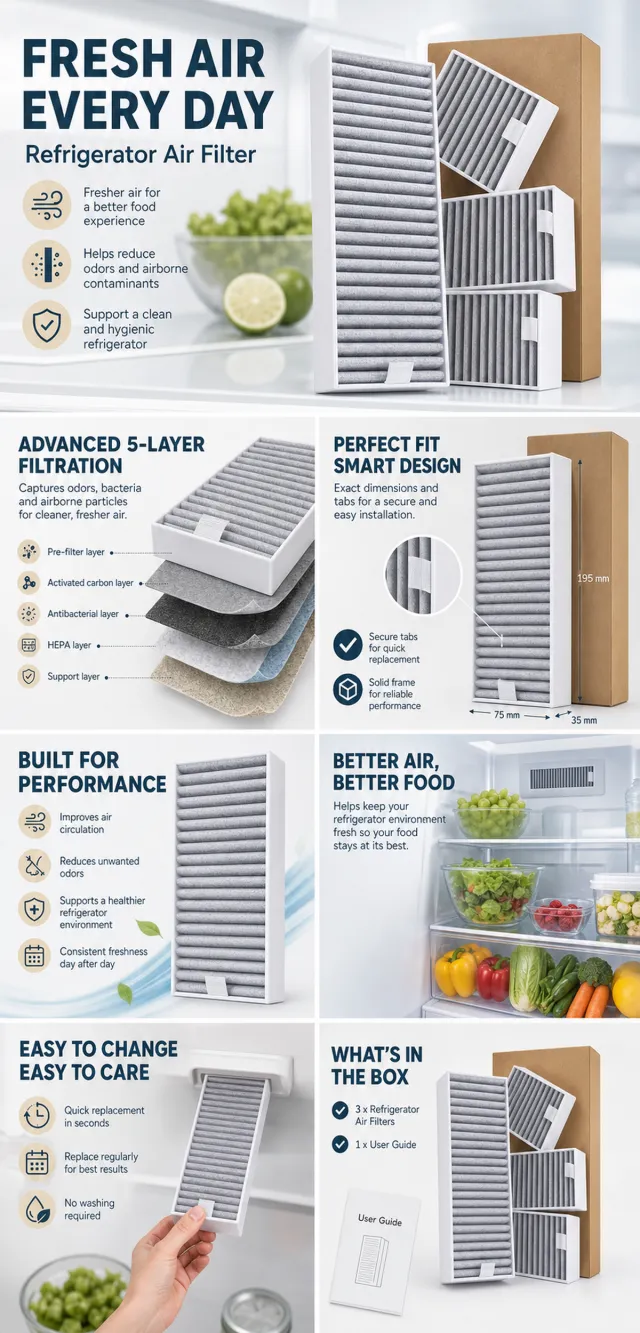
【Execution Route | Do Not Display】 If the image-generation tool can be invoked multiple times: concatenate the sharing rules with A–F separately, execute six times, generating only one 1000×1000 square image each time. If only a single image can be generated at a time: first set the interface/API to a 2:3 portrait orientation (do not use Auto), then arrange A/B, C/D, and E/F into a 2-column × 3-row grid; ensure all six cells are equal in size and maintain a visual aspect ratio of 1:1. The outer canvas must not be 1:1. 【Sharing Rules】 The provided product reference image serves as the sole basis for the product. The product is a refrigerator air filter. Strictly adhere to the reference image’s shape, structure, color, quantity, accessories, texture, and relative proportions; do not fabricate any unseen components, specifications, or functions. Use high-quality Amazon commercial photography and clear English infographics, with colors derived from the product itself, realistic lighting, and a clean layout. Maintain natural proportions for the product, figures, hands, icons, and props—no stretching, flattening, or independent scaling is allowed. Titles, products, and labels must remain fully within the safe zone, and the background should extend across the entire frame on all four sides. Only use MOCKUP for branding. No white borders, vertical edges on either side, transparent fill-in areas, watermarks, contact information, social media accounts, original brand logos, platform identifiers, garbled text, distorted body parts, or unverified copywriting are permitted. A–F are solely control markers and must not be displayed. 【A | Product Overview】Title: “PRODUCT OVERVIEW.” The hero composition fully showcases the product along with the accessories depicted in the reference image, accompanied by three brief English icon-based selling points that highlight only visible or verifiable information. 【B | Materials & Design】Title: “MATERIAL & DESIGN.” Present materials, structure, surface finishes, or styling through an overall view of the product combined with 2–3 close-up details; ensure clear labeling without inventing material names. 【C | Function in Focus】Title: “FUNCTION IN FOCUS.” Demonstrate key functions within realistic usage scenarios; maintain natural proportions among people, hands, and the product, with authentic actions and easily understandable information. 【D | Details Up Close】Title: “DETAILS UP CLOSE.” Highlight 2–4 critical structural or operational areas using magnified details and short captions; do not alter the product’s structure. 【E | Everyday Use】Title: “MADE FOR REAL LIFE.” Showcase usage, portability, storage, or maintenance scenarios consistent with the product; retain only one clear theme and avoid duplication with C. 【F | Packaging Contents】Title: “WHAT’S INCLUDED.” Lay out or neatly arrange the actual products and accessories shown in the reference image, ensuring accurate quantities and relative sizes; if the list cannot be confirmed, instead display visible specifications, dimensional relationships, or usage steps without fabricating numbers.

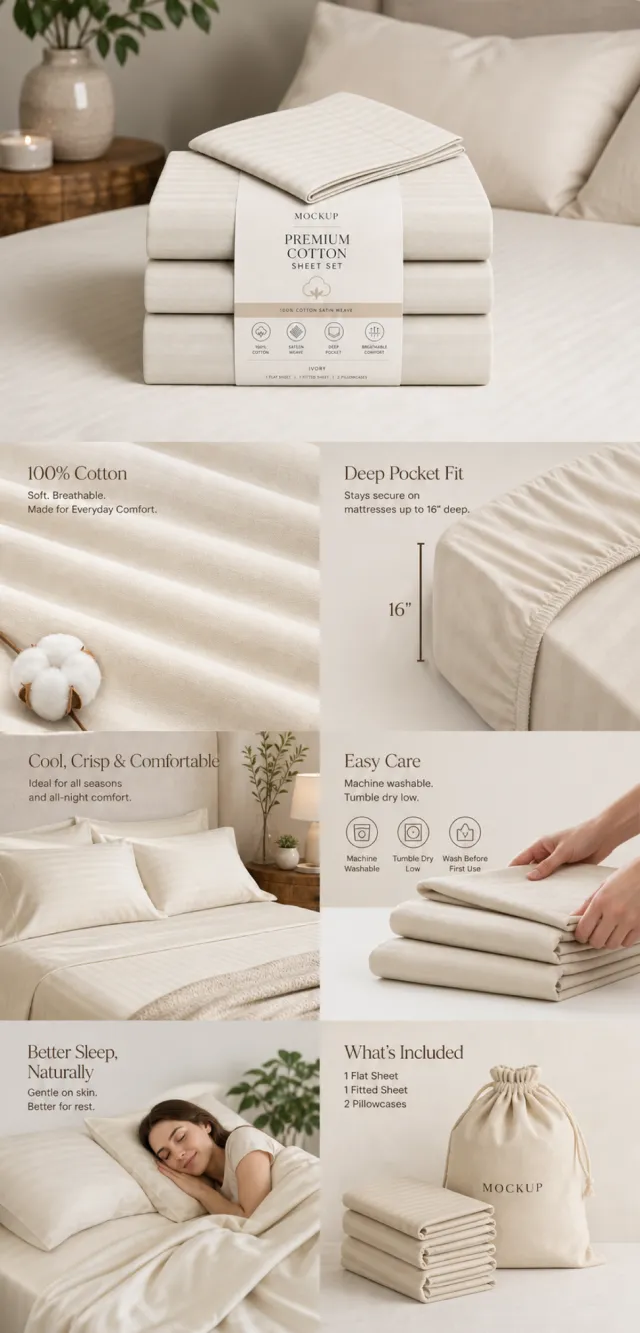
【Execution Route | Must Not Appear on Screen】 If the image-generation tool can be invoked multiple times: concatenate the sharing rules with A–F separately and execute six times; each time, generate only one independent 1000×1000 square image, resulting in six sub-images. If single‑shot generation is permitted: use a 2:3 vertical canvas measuring 1200×2500, with the top approximately 30% reserved for the product’s main visual integrated into the background, and arrange the remaining area into a 2‑column × 3‑row grid labeled A/B, C/D, and E/F. All six cards should be equal in size, with visual proportions close to 1:1. Do not use an outer 1:1 canvas, nor full‑width cards, cross‑column cards, merged cards, borders, frames, or white margins. 【Sharing Rules】 The provided product reference image serves as the sole basis for the product’s appearance, structure, color, quantity, accessories, and relative proportions. Product orientation: cream‑colored pure cotton bed sheet sets, foldable sheets and pillowcases, and fabric straps; bedroom setting, soft texture, appropriate dimensions, and care instructions. The product itself, along with any newly generated characters, animals, props, or text, must maintain natural proportions—stretching, flattening, or non‑uniform scaling is prohibited—and the background must extend fully across all four edges. Branding must uniformly follow the MOCKUP style; remove original branding, logos, watermarks, contact information, social media accounts, platform details, gibberish, and irrelevant content. Copywriting should be concise, clear, and credible, maintaining the language of the reference image, without adding unsubstantiated absolute claims or medical promises. A–F are merely control markers and must not appear on screen. 【A | Core Selling Point】 Highlight the product’s most important value and its primary subject; keep the headline short and clear. 【B | Structure & Material】 Showcase key structural elements, materials, or components using close‑up shots or simple annotations, adhering to the product’s intended direction. 【C | Real‑World Use】 Generate natural scenes featuring people, animals, or everyday life to demonstrate realistic usage, ensuring proportions and actions appear believable. 【D | Details & Steps】 Use close‑ups, step‑by‑step illustrations, or flowcharts to explain operations, textures, interfaces, storage solutions, or maintenance details. 【E | Lifestyle】 Demonstrate how the product seamlessly integrates into daily life scenarios such as home, commuting, outdoor activities, travel, or work. 【F | Sets & Carrying】 Accurately depict the product, its accessories, quantities, and storage relationships; do not add any components absent from the reference image.

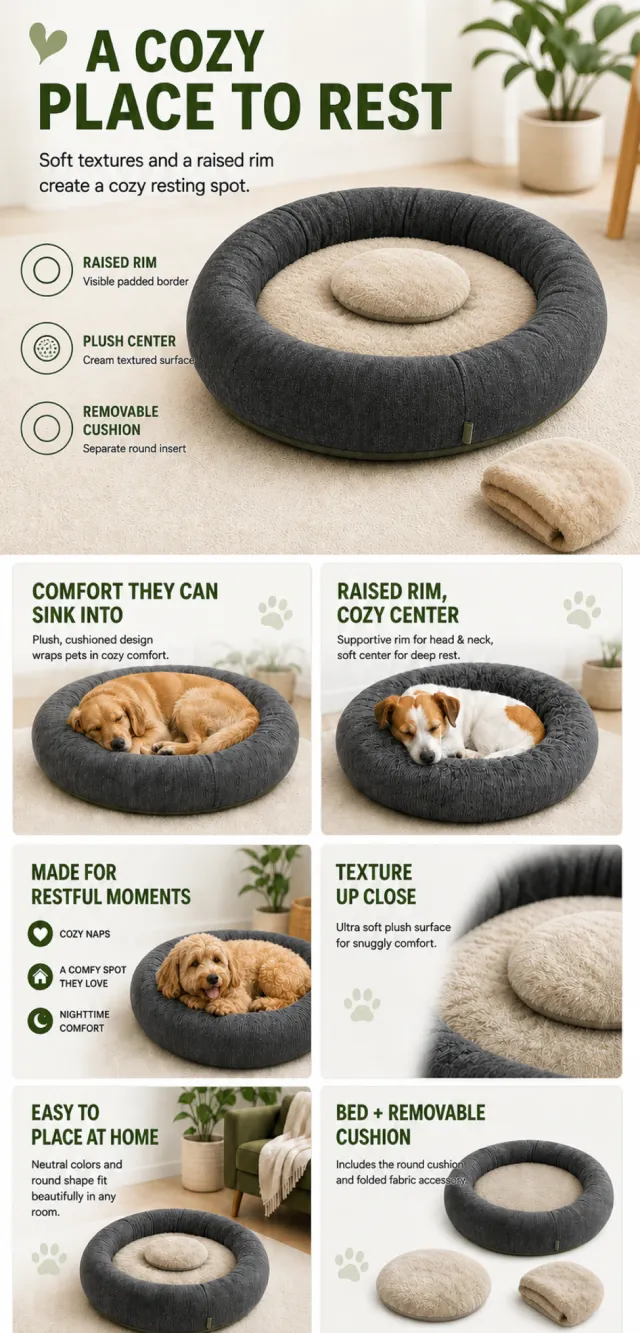
【Execution Route | Must Not Appear on Screen】 If the image-generation tool can be invoked multiple times: concatenate the sharing rules with A–F separately, and execute six times; each time, generate only one 1000×1000 square image. If only a single image can be generated at a time: first set the interface/API to a 2:3 portrait orientation and disable Auto; then arrange images in a 2-column × 3-row grid labeled A/B, C/D, and E/F. All six cells must be equal in size, with a visual aspect ratio of 1:1. Do not use an outer canvas with a 1:1 ratio. 【Sharing Rules】 Use the provided product reference image as the sole basis for product appearance, structure, color, quantity, accessories, and relative proportions. The product is a dark gray, round pet bed featuring thick, raised edges, a cream-colored velour center, and a removable small round cushion, accompanied by a foldable cream-colored fabric accessory. Visuals should evoke a calm, home‑style pet aesthetic using cream white, sage green, and dark gray, with bold English typography and soft, natural lighting. Maintain natural proportions for products, people, animals, text, icons, and props—no stretching or independent scaling allowed. Ensure all essential information remains within the safe area, with the background extending fully across all four sides. Use “MOCKUP” exclusively for branding. Remove any peripheral white borders, vertical sidebars, numbered corner marks, watermarks, contact details, social media accounts, original brand logos, platform information, gibberish, distorted limbs, or unrelated elements. People and animals must be newly rendered. Copy should be concise, readable, and trustworthy; A–F are solely control markers and must not appear on screen. 【A | Core Comfort】Title: “COMFORT THEY CAN SINK INTO.” Feature a hero shot of a newly generated dog curled up on the bed, with the raised edges and central cushion fully visible. 【B | Structural Design】Title: “RAISED RIM, COZY CENTER.” Present a cross-sectional view showcasing the thick raised edges, velour center, and small round cushion, maintaining their true thickness. 【C | Resting Scene】Title: “MADE FOR RESTFUL MOMENTS.” Depict a newly generated cat or dog resting peacefully in a quiet living room, with the pet and bed appearing naturally scaled. 【D | Material Details】Title: “TEXTURE UP CLOSE.” Capture four circular macro shots highlighting the dark gray fabric, cream-colored velour, stitching, and bottom edging. 【E | Home Fit】Title: “EASY TO PLACE AT HOME.” Show the pet bed in three settings—living room, bedroom, and a quiet corner—using the same size throughout. 【F | Package Contents】Title: “BED + REMOVABLE CUSHION.” Display the pet bed, small round cushion, and foldable fabric accessory laid out flat, ensuring accurate quantities and proportions.

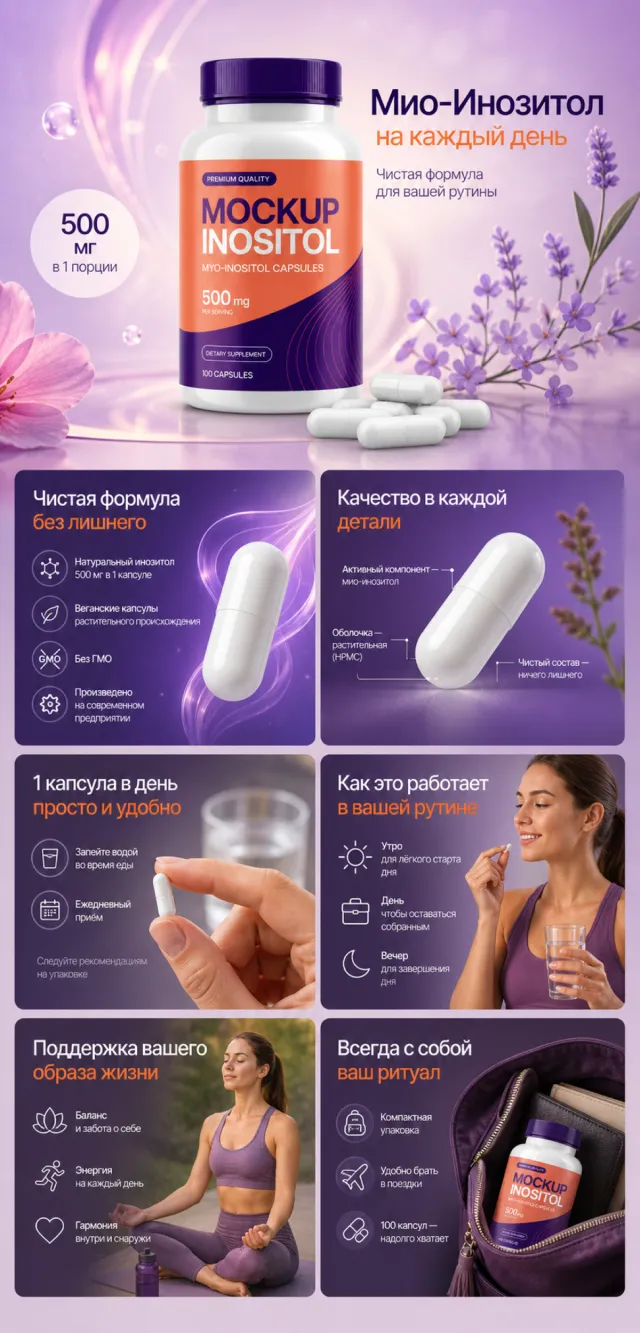
【Execution Route | Must Not Appear on Screen】 If the image-generation tool can be invoked multiple times: concatenate the sharing rules with A–F separately and execute six times; each time, generate only one independent 1000×1000 square image, resulting in six sub-images. If single‑shot generation is permitted: use a 2:3 vertical canvas measuring 1200×2500, with approximately 30% at the top reserved for the product’s main visual integrated into the background, and arrange the remaining area into a 2‑column × 3‑row grid labeled A/B, C/D, and E/F. All six cards should be equal in size, with an aspect ratio close to 1:1. Do not use a 1:1 outer canvas, nor full‑width cards, cross‑column cards, merged cards, borders, frames, or white margins. 【Sharing Rules】 The provided product reference image serves as the sole basis for the product’s appearance, structure, color, quantity, accessories, and relative proportions. Product orientation: white and purple inositol supplement bottle, purple cap, coral‑purple label, and white capsules; designed for everyday use and portability, avoiding any medical claims. The product itself, along with newly generated characters, animals, props, and text, must maintain natural proportions—stretching, flattening, or non‑uniform scaling is prohibited—and the background must extend fully across all four edges. Branding must uniformly follow the MOCKUP style; remove original branding, logos, watermarks, contact information, social media accounts, platform details, gibberish, and irrelevant content. Copywriting should be concise, clear, and credible, maintaining the language of the reference image without adding unsupported absolute or medical claims. A–F are merely control markers and must not appear on screen. 【A | Core Selling Point】 Highlight the product’s most important value and its complete main subject; keep the title short and clear. 【B | Structure and Materials】 Showcase key structural elements, materials, or components using close-up shots or simple annotations, adhering to the product’s intended direction. 【C | Real‑World Use】 Generate natural human/animal figures or real-life scenes to demonstrate authentic usage, ensuring proportions and actions appear believable. 【D | Details and Steps】 Use close-ups, step-by-step illustrations, or flowcharts to explain operations, textures, interfaces, storage solutions, or care instructions. 【E | Lifestyle】 Depict how the product naturally integrates into family life, commuting, outdoor activities, travel, or work settings. 【F | Sets and Portability】 Accurately present the product, its accessories, quantities, and storage relationships; do not add any components absent from the reference image.

【Execution Route | Must Not Appear on Screen】 If the image-generation tool can be invoked multiple times: concatenate the sharing rules with A–F separately, and execute six times; each time generating only one independent 1000×1000 square image, resulting in six sub‑images. If only single‑shot generation is allowed: use a 2:3 vertical canvas measuring 1200×2500, with the top approximately 30% reserved for the product’s main visual integrated into the background, and arrange A/B, C/D, and E/F in two columns by three rows to form a six‑grid layout; all six cards should be equal in size and maintain an aspect ratio close to 1:1. Do not use a 1:1 outer canvas, nor full‑width cards, cross‑column cards, merged cards, borders, frames, or white margins. 【Sharing Rules】 The provided product reference image serves as the sole basis for the product’s appearance, structure, color, quantity, accessories, and relative proportions. Product orientation: dark gray adjustable dumbbells paired with round weight plates; focusing on grip, weight adjustment, exercise movements, storage, and space efficiency. The product itself, along with any newly generated characters, animals, props, or text, must retain natural proportions; stretching, flattening, or non‑uniform scaling is prohibited. The background should extend fully across the entire canvas, reaching all four edges. Branding must uniformly use MOCKUP; remove original branding, logos, watermarks, contact information, social media accounts, platform details, gibberish, and irrelevant content. Copywriting should be concise, clear, and credible, maintaining the language of the reference image, without adding unsubstantiated absolute claims or medical promises. A–F are merely control markers and must not appear on screen. 【A | Core Selling Point】 Highlight the product’s most important value and its primary subject; keep the headline short and clear. 【B | Structure and Materials】 Showcase the product’s key structural elements, materials, or components using close‑up shots or simple annotations, adhering to the product’s intended direction. 【C | Real‑World Use】 Generate natural scenes featuring people, animals, or everyday life to demonstrate realistic usage, ensuring proportions and actions appear believable. 【D | Details and Steps】 Use close‑ups, step‑by‑step instructions, or flowcharts to explain operations, textures, interfaces, storage solutions, or maintenance details. 【E | Lifestyle】 Illustrate how the product seamlessly integrates into daily life—whether at home, during commuting, outdoors, while traveling, or at work. 【F | Sets and Portability】 Accurately depict the product, its accessories, quantities, and storage relationships; do not add any components absent from the reference image.

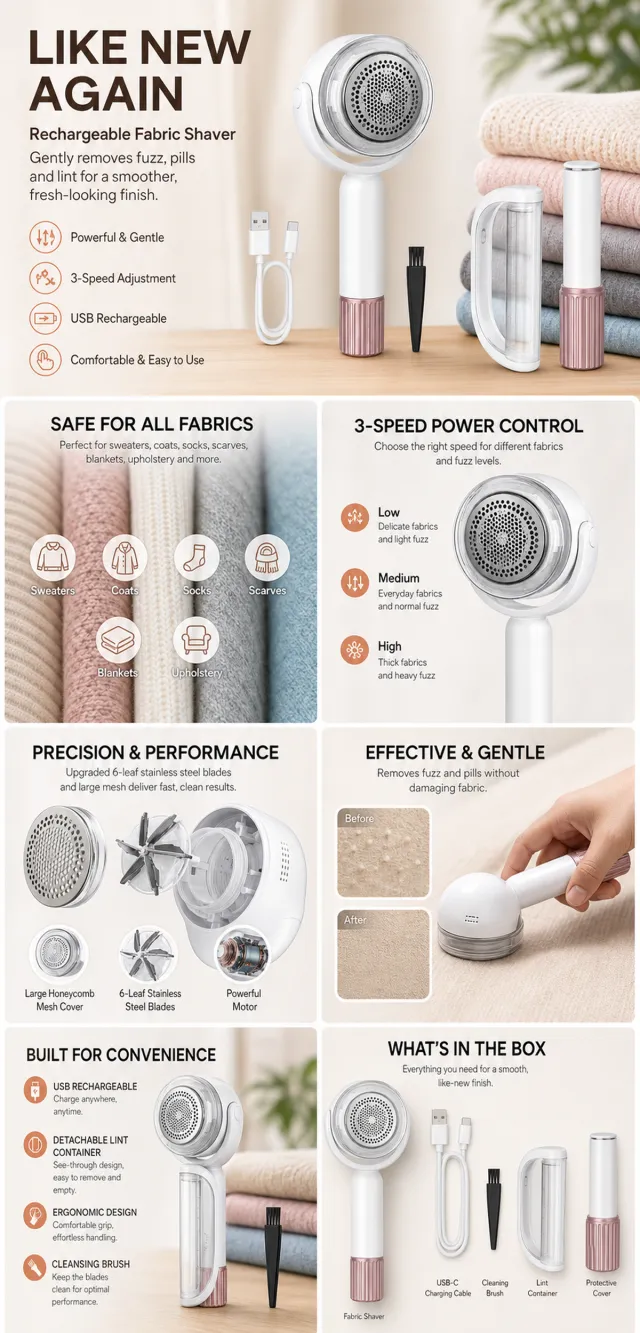
【Execution Route | Do Not Display】 If the image-generation tool can be invoked multiple times: concatenate the sharing rules with A–F separately, execute six times, generating only one 1000×1000 square image each time. If only a single image can be generated at a time: first set the interface/API to a 2:3 portrait orientation (do not use Auto), then arrange A/B, C/D, and E/F into a 2-column × 3-row grid; ensure all six cells are equal in size and maintain a visual aspect ratio of 1:1. The outer canvas must not be 1:1. 【Sharing Rules】 The provided product reference image serves as the sole basis for the product. The product is a rechargeable fabric shaver. Strictly adhere to the reference image’s shape, structure, color, quantity, accessories, texture, and relative proportions; do not invent or add unshown components, specifications, or functions. Use high-quality Amazon commercial photography and clear English infographics, with colors derived from the product, realistic lighting, and a clean layout. Maintain natural proportions for the product, figures, hands, icons, and props; stretching, flattening, or independently scaling is prohibited. Headlines, products, and labels must remain fully within the safe area, and the background should extend across the entire frame on all four sides. Only use MOCKUP for branding. Avoid peripheral white borders, vertical edges on the left and right, transparent fill-in borders, watermarks, contact information, social media accounts, original brand logos, platform identifiers, garbled text, distorted body parts, or unverified copywriting. A–F are solely control markers and must not be displayed. 【A | Product Overview】Title: “PRODUCT OVERVIEW.” The hero composition fully showcases the product along with the accessories included in the reference image; accompany it with three brief English icon-based selling points, stating only information that is visible or verifiable. 【B | Materials & Design】Title: “MATERIAL & DESIGN.” Present materials, structure, surface finish, or styling through an overall view of the product combined with 2–3 close-up details; ensure clear labeling without fabricating material names. 【C | Function Focus】Title: “FUNCTION IN FOCUS.” Demonstrate key functions within realistic usage scenarios; maintain natural proportions among figures, hands, and the product, with actions appearing genuine and information easily understandable. 【D | Detail Close-Ups】Title: “DETAILS UP CLOSE.” Highlight 2–4 critical structural or operational areas using magnified details and short labels; do not alter the product’s structure. 【E | Everyday Use】Title: “MADE FOR REAL LIFE.” Show scenes of actual use, carrying, storage, or maintenance that align with the product; retain only one clear theme and avoid duplication with C. 【F | Packaging Contents】Title: “WHAT’S INCLUDED.” Lay out or neatly display the actual products and accessories shown in the reference image, ensuring accurate quantities and relative sizes; if the contents cannot be confirmed, instead present visible specifications, dimensional relationships, or usage steps—without fabricating numbers.

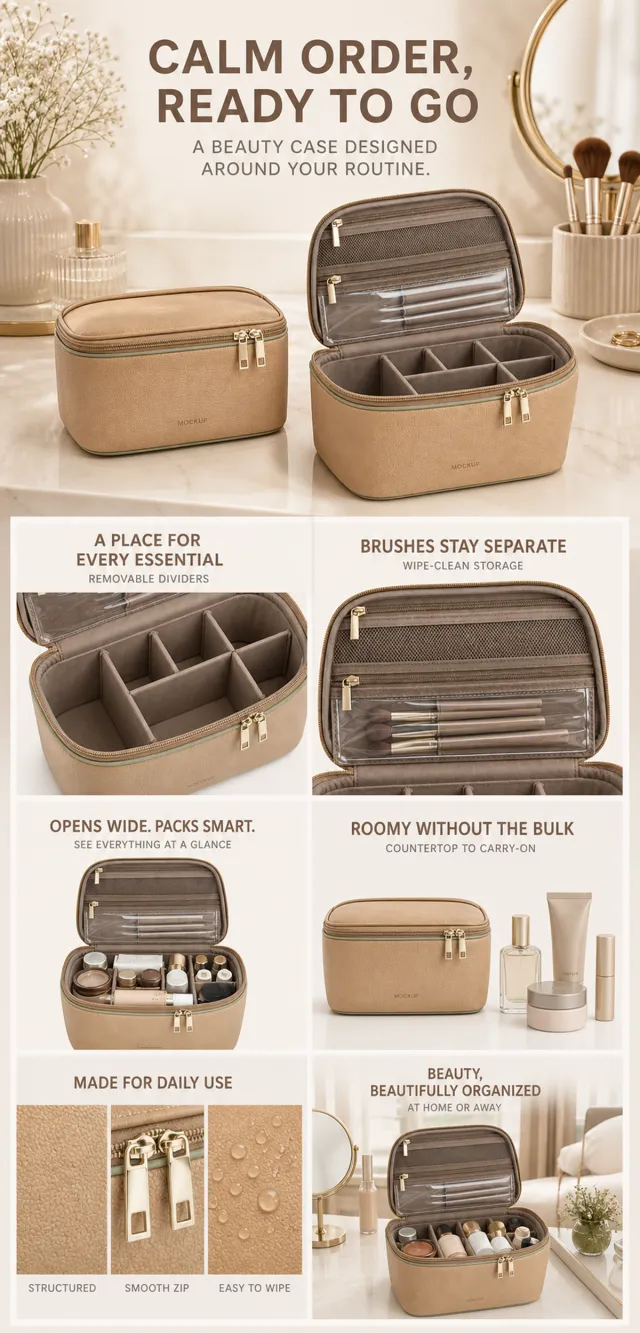
【Execution Routing | Do Not Display】 If the image-generation tool can be invoked multiple times: concatenate the sharing rules with A–F separately, execute six times, generating one 1000×1000 square image each time; do not submit all modules at once. If only one image can be generated per invocation: set the interface or API to a 2:3 portrait orientation and disable Auto mode; a recommended size is 1200×1800. Arrange A/B, C/D, and E/F into a 2-column × 3-row grid of six modules, ensuring equal module sizes and maintaining a 1:1 aspect ratio. If the platform enforces a 1:1 ratio, switch to using an Agent or generate each module individually. 【Sharing Rules】 Use the provided product reference image as the sole product basis. Product: structured makeup organizer bag. Copywriting must be in English, with brand placeholders limited to MOCKUP. Visual style should adopt a warm ivory-and-camel quiet-luxury aesthetic. The product’s appearance, structure, color, quantity, accessories, and relative proportions must match the reference image; product, figures, icons, and props should maintain natural proportions. All essential information must remain within the safe zone, with the background extending fully across all four edges. Prohibit outer white borders, vertical sidebars on left and right, transparent border extensions, watermarks, contact details, social media accounts, platform information, original branding, garbled text, irrelevant information, or unverified claims regarding efficacy or specifications; control titles must not appear. A–F must not be displayed. 【A | Theme】Copy: “CALM ORDER, READY TO GO”; “A BEAUTY CASE DESIGNED AROUND YOUR ROUTINE.” Use the full product main visual to concisely convey core value. 【B | Theme】Copy: “A PLACE FOR EVERY ESSENTIAL.” Design an independent square image around this theme, ensuring no overlap in selling points, composition, or product angles with other modules. 【C | Theme】Copy: “REMOVABLE DIVIDERS.” Design an independent square image around this theme, avoiding repetition of selling points, composition, and product angles with other modules. 【D | Theme】Copy: “BRUSHES STAY SEPARATE.” Design an independent square image around this theme, avoiding repetition of selling points, composition, and product angles with other modules. 【E | Theme】Copy: “WIPE-CLEAN STORAGE.” Design an independent square image around this theme, avoiding repetition of selling points, composition, and product angles with other modules. 【F | Theme】Copy: “OPENS WIDE. PACKS SMART”; “SEE EVERYTHING AT A GLANCE.” Design an independent square image around this theme, avoiding repetition of selling points, composition, and product angles with other modules.

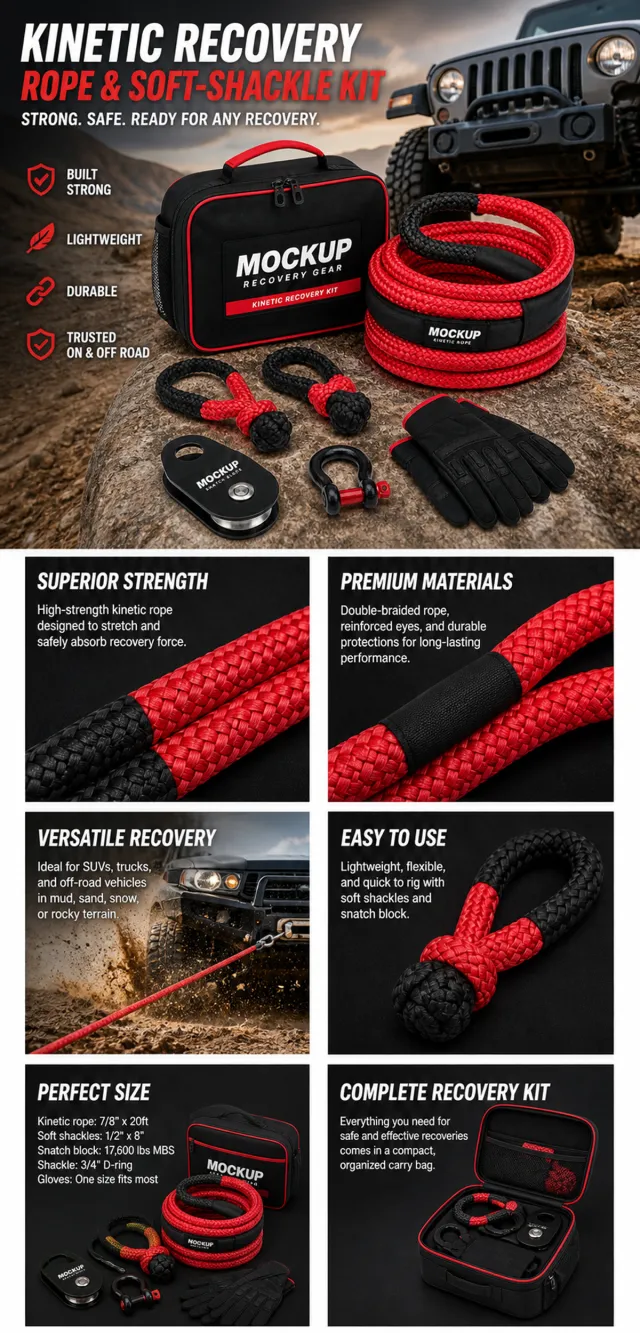
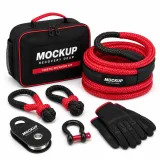
【Execution Routing | Do Not Display】 If the image-generation tool can be invoked multiple times: concatenate the sharing rules with A–F separately, execute six times, generating one 1000×1000 square image each time; do not submit all modules at once. If only one image can be generated per invocation: set the interface or API to a 2:3 portrait orientation and disable Auto mode; a recommended size is 1200×1800. Arrange A/B, C/D, and E/F into a 2-column × 3-row grid of six modules, ensuring equal module sizes and maintaining a 1:1 aspect ratio. If the platform enforces a 1:1 ratio, switch to using an Agent or generate each module individually. 【Sharing Rules】 The provided product reference image serves as the sole product basis. Product: vehicle kinetic recovery rope and soft-shackle kit. Copywriting must be in English, with brand placeholders replaced by MOCKUP only. Visuals should employ premium commercial e-commerce photography and stable graphic design. The product’s appearance, structure, color, quantity, accessories, and relative proportions must match the reference image; products, people, icons, and props must maintain natural proportions. All essential information must remain within the safe zone, with the background extending fully across all four edges. External white borders, vertical sidebars, transparent fill-in areas, watermarks, contact details, social media accounts, platform information, original branding, gibberish, irrelevant content, or unverified claims regarding efficacy or specifications are prohibited. Headlines must not be displayed. A–F must not appear. 【A | Core Selling Point】Write concise English copy focusing on this theme, using the full product main visual to highlight core value. 【B | Usage Instructions】Provide brief English copy addressing this theme, illustrating the usage process, assembly relationships, or key operations. 【C | Applicable Scenarios】Present short English copy centered on this theme, showcasing realistic, credible, and product-relevant use cases. 【D | Functional Details】Offer succinct English copy highlighting this theme, using close-up shots, cross-sections, or icons to explain structural and functional specifics. 【E | Daily Maintenance】Craft brief English copy covering this theme, demonstrating methods for use, cleaning, storage, or maintenance. 【F | Specification List】Compose concise English copy addressing this theme, listing materials, specifications, packaging details, or providing credible comparisons—without fabricating parameters.

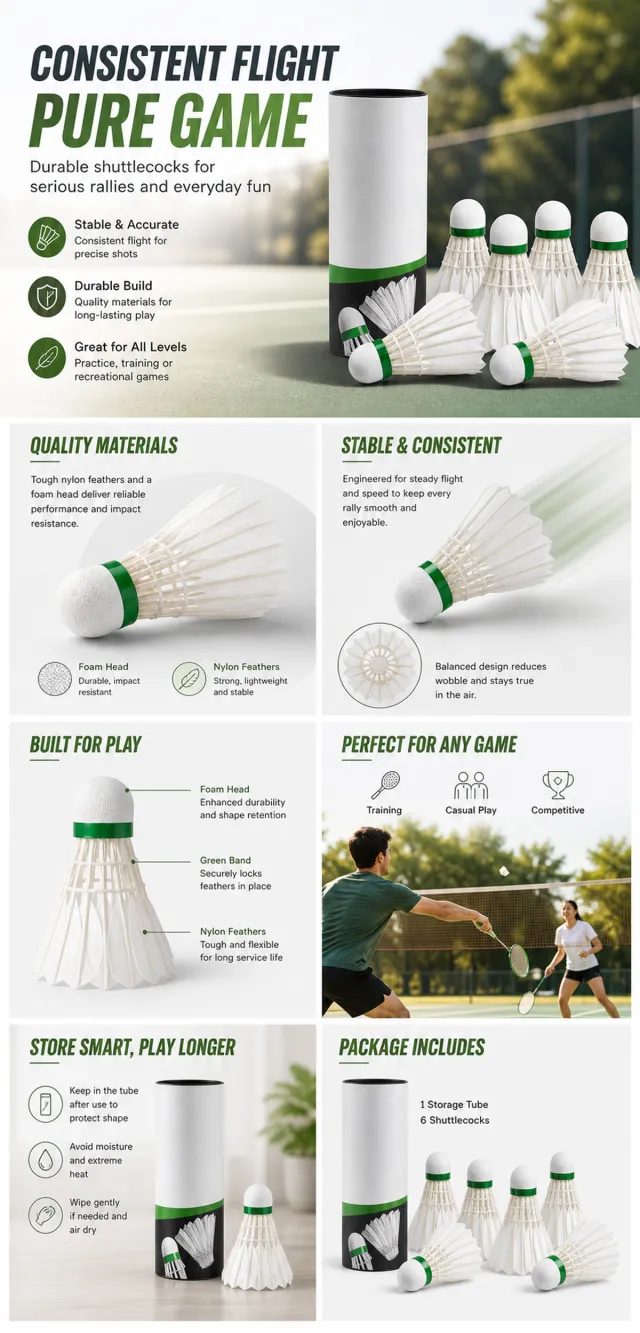
【Execution Route | Do Not Display】 If the image-generation tool can be invoked multiple times: concatenate the sharing rules with A–F separately, execute six times, generating only one 1000×1000 square image each time. If only a single image can be generated at a time: first set the interface/API to a 2:3 portrait orientation (do not use Auto), then arrange A/B, C/D, and E/F into a 2-column × 3-row grid; ensure all six cells are equal in size and maintain a visual aspect ratio of 1:1. The outer canvas must not be 1:1. 【Sharing Rules】 The provided product reference image serves as the sole basis for the product. The product is a badminton shuttlecock set. Strictly adhere to the reference image’s shape, structure, color, quantity, accessories, texture, and relative proportions; do not fabricate any unseen components, specifications, or functions. Use high-quality Amazon commercial photography and clear English infographics, with colors derived from the product, realistic lighting, and a clean layout. Maintain natural proportions for the product, figures, hands, icons, and props; stretching, flattening, or independently scaling is prohibited. Titles, products, and labels must remain fully within the safe zone, with the background extending evenly to all four edges. Only use MOCKUP for branding. Avoid peripheral white borders, vertical sidebars, transparent fill-in borders, watermarks, contact information, social media accounts, original brand logos, platform identifiers, garbled text, distorted body parts, or unverified copywriting. A–F are solely control markers and must not be displayed. 【A | Product Overview】Title: “PRODUCT OVERVIEW.” The hero composition should fully showcase the product along with the accessories included in the reference image, accompanied by three brief English icon-based selling points that highlight only visible or verifiable information. 【B | Materials & Design】Title: “MATERIAL & DESIGN.” Present materials, structure, surface finishes, or styling through an overall view of the product combined with 2–3 close-up details; ensure clear labeling without inventing material names. 【C | Function in Focus】Title: “FUNCTION IN FOCUS.” Demonstrate key functions within realistic usage scenarios; maintain natural proportions among figures, hands, and the product, with authentic actions and easily understandable information. 【D | Details Up Close】Title: “DETAILS UP CLOSE.” Highlight 2–4 critical structural or operational areas using magnified details and short captions; do not alter the product’s structure. 【E | Everyday Use】Title: “MADE FOR REAL LIFE.” Showcase usage, carrying, storage, or maintenance scenarios consistent with the product; focus on a single clear theme and avoid redundancy with C. 【F | Packaging Contents】Title: “WHAT’S INCLUDED.” Lay out or neatly display the actual products and accessories shown in the reference image, ensuring accurate quantities and relative sizes; if the contents cannot be confirmed, instead present visible specifications, dimensional relationships, or usage steps without fabricating numbers.

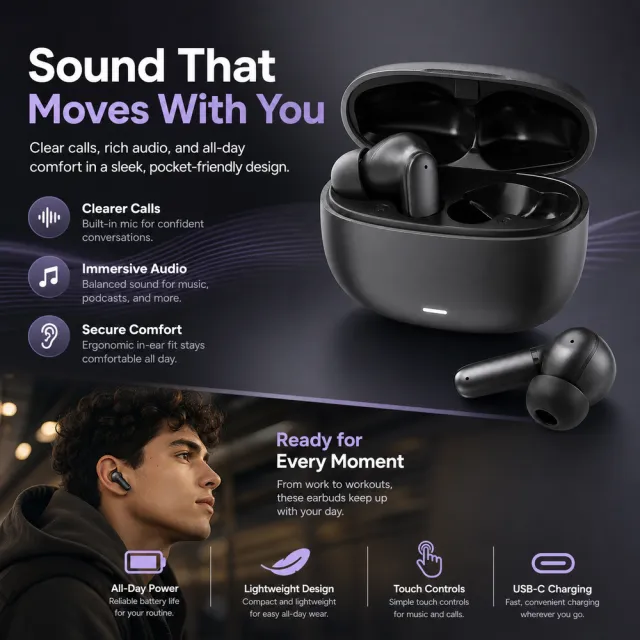
【Output Guidelines | Do Not Display】 Generate only one 1000×1000, 1:1 Amazon Listing secondary image. No collages, six‑panel grids, storyboards, multi‑card grids, or multiple images are permitted. 【Sharing Guidelines】 Use the provided product reference image as the sole basis for all elements. The product is true wireless earbuds with a charging case. Strictly adhere to the reference image’s shape, structure, color, quantity, accessories, texture, and relative proportions; do not invent any components, specifications, or features that are not shown. Employ high‑quality Amazon commercial photography and clear English infographics, with colors derived from the product, realistic lighting, and a clean layout. Maintain natural proportions for the product, human figures, hands, icons, and props—no stretching, flattening, or independent scaling is allowed. Ensure that the title, product, and labels remain fully within the safe area, and extend the background across the entire frame to all four edges. Use “MOCKUP” exclusively for branding. Avoid white borders, vertical bars on the sides, transparent fill‑ins, watermarks, contact information, social media accounts, original brand logos, platform identifiers, garbled text, distorted body parts, or unverified copy. 【Image Composition】 Title: “EVERYDAY WIRELESS SOUND.” Present only one complete image: the product serves as the sole visual focal point, displayed in its optimal angle as confirmed by the reference image, preserving natural proportions, contours, and accessories. Use a harmonious real‑world scene or a high‑end studio backdrop. Include 2–3 brief English icon‑based selling points, limited to information visible in the reference image or reasonably verifiable; all text must be clear, complete, and free of obstructions. Split screens, repeated product walls, and additional small cards are prohibited.

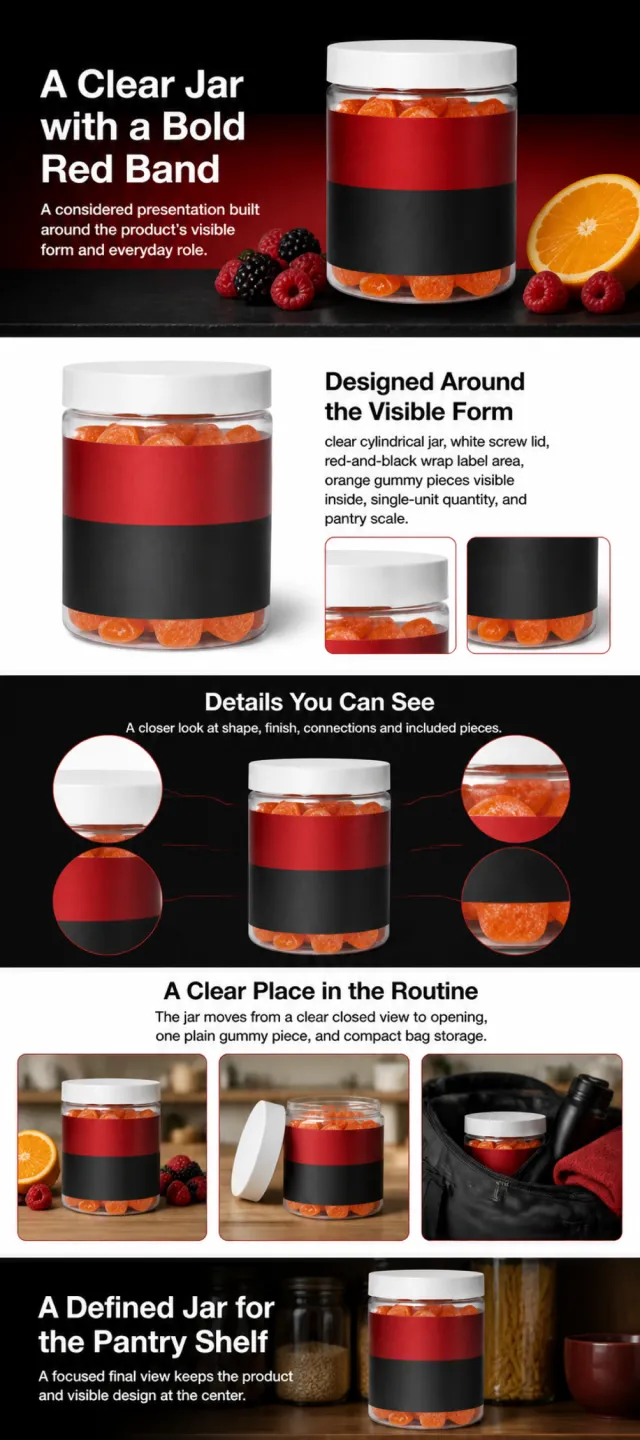
Using the supplied reference image as the sole product reference, create an Amazon A+ design preview for a gummy-supplement jar. Preserve exact geometry, proportions, colors, construction, quantity, accessories, and scale. Visible details: clear cylindrical jar, white screw lid, red-and-black wrap label area, orange gummy pieces visible inside, single-unit quantity, and pantry scale. Do not invent hidden parts or claims. Visual system: black, vivid red, white, orange, and berry accents. Composition motifs: high-contrast dark panels, red horizontal bands, fruit still lifes, and gym-bag storage scenes. Alternate a wide banner, asymmetric overview, centered detail graphic, three-scene sequence, and wide closing scene. Use readable sans-serif type and mobile-safe margins. Build this official A+ module order. Keep every module independently complete; never split copy or product details. MODULE 1 — Image with text overlay — introduction Exact headline: “A Clear Jar with a Bold Red Band” Exact supporting copy: “A considered presentation built around the product’s visible form and everyday role.” Layout: wide image-led hero; dominant complete product and large safe headline area. MODULE 2 — Single image with side text — product overview Exact headline: “Designed Around the Visible Form” Exact supporting copy: “clear cylindrical jar, white screw lid, red-and-black wrap label area, orange gummy pieces visible inside, single-unit quantity, and pantry scale.” Layout: large three-quarter product, side text field, and two detail crops. MODULE 3 — Four-image and text — visible evidence Exact headline: “Details You Can See” Exact supporting copy: “A closer look at shape, finish, connections and included pieces.” Layout: centered product with four rounded macro callouts; show only visible facts. MODULE 4 — Multiple image and text — routine or use setting Exact headline: “A Clear Place in the Routine” Exact supporting copy: “The jar moves from a clear closed view to opening, one plain gummy piece, and compact bag storage.” Layout: three framed scenes with consistent product design and newly generated people or animals only when relevant. MODULE 5 — Full-width image with text overlay — closing Exact headline: “A Defined Jar for the Pantry Shelf” Exact supporting copy: “A focused final view keeps the product and visible design at the center.” Layout: wide editorial scene, strong silhouette, restrained props, safe text area. Create one vertical A+ preview at 1200px width with content-driven height, clear module boundaries, and varied compositions for independent export. Render only the exact copy above. Do not add logos, prices, promotions, QR codes, URLs, contacts, competitors, testimonials, ratings, guarantees, unverified claims, certifications, fake UI, watermarks, pseudo-text, or unrelated labels. Keep all elements natural and mobile-safe.

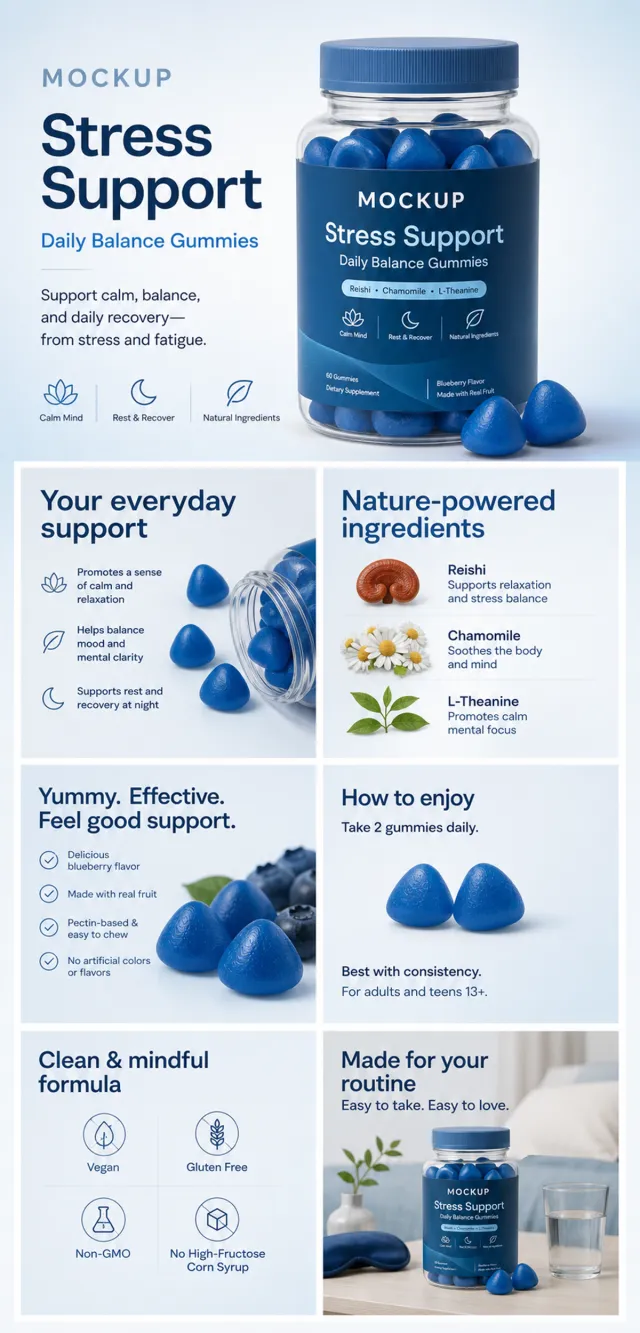
【Execution Routing | Do Not Display】 If the image-generation tool can be invoked multiple times: concatenate the sharing rules with A–F separately, execute six times, generating one 1000×1000 square image each time; do not submit all modules at once. If only one image can be generated per invocation: set the interface or API to a 2:3 portrait orientation and disable Auto mode; a recommended size is 1200×1800. Arrange A/B, C/D, and E/F into a 2-column × 3-row grid of six modules, ensuring equal module sizes and maintaining a 1:1 aspect ratio. If the platform enforces a 1:1 ratio, switch to using an Agent or generate each module individually. 【Sharing Rules】 The provided product reference image serves as the sole basis for the product. Product: blue vitality dietary supplement. Copywriting must be in English, with brand placeholders replaced by MOCKUP only. Visuals should employ premium commercial e-commerce photography and stable graphic design. The product’s appearance, structure, color, quantity, accessories, and relative proportions must match the reference image; products, people, icons, and props should maintain natural proportions. All essential information must remain within the safe zone, with the background extending fully to all four edges. External white borders, vertical borders on left and right, transparent fill-in borders, watermarks, contact details, social media accounts, platform information, original branding, gibberish, irrelevant content, or unverified claims regarding efficacy or specifications are prohibited. Headlines must not be displayed. A–F must not appear. 【A | Core Selling Point】Write concise English copy that highlights this theme, focusing on the core value through the full product visual. 【B | Usage Instructions】Provide brief English copy addressing this theme, illustrating the usage process, combinations, or key operations. 【C | Applicable Scenarios】Present short English copy centered on this theme, showcasing realistic, credible, and product-relevant usage scenarios. 【D | Functional Details】Offer succinct English copy explaining this theme, using close-up shots, cross-sections, or icons to clarify structural and functional details. 【E | Daily Maintenance】Craft brief English copy covering this theme, demonstrating methods for use, cleaning, storage, or maintenance. 【F | Specification List】Compose concise English copy addressing this theme, listing materials, specifications, packaging details, or providing credible comparisons—without fabricating parameters.

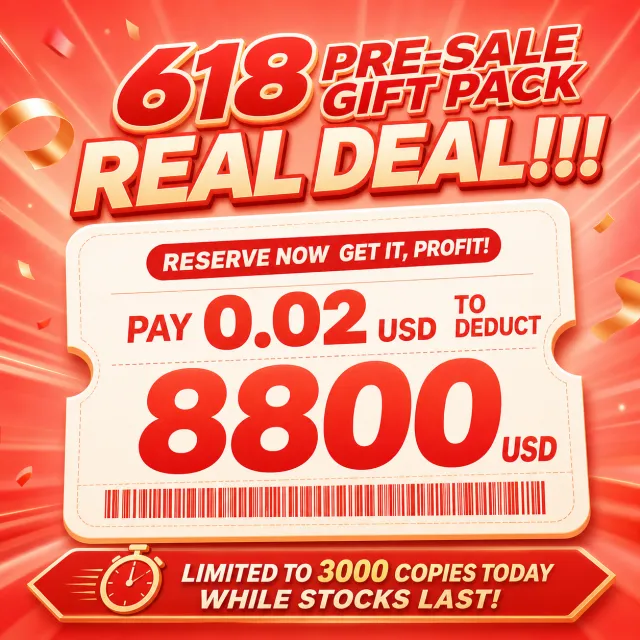
Create an original square e-commerce presale coupon poster. Use a coral-red and peach gradient background, large headline “618超前礼包” and “真的降!!!”, a white coupon card with side notches and barcode, and a bottom urgency strip. Text: “立即预定 抢到赚到”, “0.02元抵”, “8800元”, “今日限量3000份 抢完即止!”. No logo, watermark, QR code, website, or note text.

【Execution Route | Must Not Appear on Screen】 If the image-generation tool can be invoked multiple times: concatenate the sharing rules with A–F separately, and execute six times; each time, generate only one independent 1000×1000 square image, resulting in six sub‑images. If single‑shot generation is permitted: use a 2:3 vertical canvas measuring 1200×2500, with the top approximately 30% reserved for the product’s main visual integrated into the background, and arrange A/B, C/D, and E/F in a 2‑column × 3‑row grid below. All six cards should be equal in size, with visual proportions close to 1:1. Do not use an outer 1:1 canvas, nor full‑width cards, cross‑column cards, merged cards, borders, frames, or white margins. 【Sharing Rules】 The provided product reference image serves as the sole basis for the product’s appearance, structure, color, quantity, accessories, and relative proportions. Product orientation: blue hydrating facial mask/cream jar, white cap, and refreshing label; moisturizing texture, application method, bathroom setting, and portability. The product itself, along with any newly generated characters, animals, props, or text, must maintain natural proportions—stretching, flattening, or non‑uniform scaling is prohibited—and the background must extend fully across all four edges. Branding must uniformly follow MOCKUP standards; remove original branding, logos, watermarks, contact information, social media accounts, platform details, gibberish, and irrelevant content. Copywriting should be concise, clear, and credible, retaining the language of the reference image, without adding unsubstantiated absolute claims or medical promises. A–F are merely control markers and must not appear on screen. 【A | Core Selling Point】 Highlight the product’s most important value and its complete main subject; keep the headline short and clear. 【B | Structure and Materials】 Showcase key structural elements, materials, or components using close‑up shots or simple annotations, adhering to the product’s intended direction. 【C | Real‑World Use】 Generate natural human/animal figures or everyday scenes to demonstrate realistic usage, ensuring proportions and actions appear believable. 【D | Details and Steps】 Use close‑ups, step‑by‑step instructions, or flowcharts to explain operations, textures, interfaces, storage solutions, or care details. 【E | Lifestyle】 Illustrate how the product naturally integrates into family life, commuting, outdoor activities, travel, or work settings. 【F | Sets and Portability】 Accurately depict the product, its accessories, quantities, and storage relationships; do not add any components absent from the reference image.

Using the supplied reference image as the sole product reference, create an Amazon A+ design preview for a tall upholstered bar stool. Preserve exact geometry, proportions, colors, construction, quantity, accessories, and scale. Visible details: brown leather-look molded seat, stitched channel details, four slim black metal legs, circular footrest, single-stool quantity, and counter scale. Do not invent hidden parts or claims. Visual system: cognac brown, black, warm beige, and restrained gold. Composition motifs: wide kitchen scenes, angled seam close-ups, circular base details, and assembly silhouettes. Alternate a wide banner, asymmetric overview, centered detail graphic, three-scene sequence, and wide closing scene. Use readable sans-serif type and mobile-safe margins. Build this official A+ module order. Keep every module independently complete; never split copy or product details. MODULE 1 — Image with text overlay — introduction Exact headline: “A Cognac Stool with a Tall Silhouette” Exact supporting copy: “A considered presentation built around the product’s visible form and everyday role.” Layout: wide image-led hero; dominant complete product and large safe headline area. MODULE 2 — Single image with side text — product overview Exact headline: “Designed Around the Visible Form” Exact supporting copy: “brown leather-look molded seat, stitched channel details, four slim black metal legs, circular footrest, single-stool quantity, and counter scale.” Layout: large three-quarter product, side text field, and two detail crops. MODULE 3 — Four-image and text — visible evidence Exact headline: “Details You Can See” Exact supporting copy: “A closer look at shape, finish, connections and included pieces.” Layout: centered product with four rounded macro callouts; show only visible facts. MODULE 4 — Multiple image and text — routine or use setting Exact headline: “A Clear Place in the Routine” Exact supporting copy: “The stool moves from a clean product view to kitchen-counter placement and a casual dining setting.” Layout: three framed scenes with consistent product design and newly generated people or animals only when relevant. MODULE 5 — Full-width image with text overlay — closing Exact headline: “A Defined Seat for Counter-Height Spaces” Exact supporting copy: “A focused final view keeps the product and visible design at the center.” Layout: wide editorial scene, strong silhouette, restrained props, safe text area. Create one vertical A+ preview at 1200px width with content-driven height, clear module boundaries, and varied compositions for independent export. Render only the exact copy above. Do not add logos, prices, promotions, QR codes, URLs, contacts, competitors, testimonials, ratings, guarantees, unverified claims, certifications, fake UI, watermarks, pseudo-text, or unrelated labels. Keep all elements natural and mobile-safe.

Using the supplied reference image as the sole product reference, create an Amazon A+ design preview for a two-jar instant-coffee set. Preserve exact geometry, proportions, colors, construction, quantity, accessories, and scale. Visible details: two matching clear cylindrical jars, black lids, burgundy wrap label areas, visible brown granules, complete two-unit quantity, and pantry scale. Do not invent hidden parts or claims. Visual system: espresso brown, burgundy, black, warm gold, and cream. Composition motifs: dark café interiors, floating coffee beans, wide drink triptychs, and warm pedestal scenes. Alternate a wide banner, asymmetric overview, centered detail graphic, three-scene sequence, and wide closing scene. Use readable sans-serif type and mobile-safe margins. Build this official A+ module order. Keep every module independently complete; never split copy or product details. MODULE 1 — Image with text overlay — introduction Exact headline: “A Two-Jar Coffee Set in Burgundy” Exact supporting copy: “A considered presentation built around the product’s visible form and everyday role.” Layout: wide image-led hero; dominant complete product and large safe headline area. MODULE 2 — Single image with side text — product overview Exact headline: “Designed Around the Visible Form” Exact supporting copy: “two matching clear cylindrical jars, black lids, burgundy wrap label areas, visible brown granules, complete two-unit quantity, and pantry scale.” Layout: large three-quarter product, side text field, and two detail crops. MODULE 3 — Four-image and text — visible evidence Exact headline: “Details You Can See” Exact supporting copy: “A closer look at shape, finish, connections and included pieces.” Layout: centered product with four rounded macro callouts; show only visible facts. MODULE 4 — Multiple image and text — routine or use setting Exact headline: “A Clear Place in the Routine” Exact supporting copy: “The jars move from a clear paired view to opening, one measured serving, and hot and iced drink settings.” Layout: three framed scenes with consistent product design and newly generated people or animals only when relevant. MODULE 5 — Full-width image with text overlay — closing Exact headline: “A Warm Pair for the Coffee Shelf” Exact supporting copy: “A focused final view keeps the product and visible design at the center.” Layout: wide editorial scene, strong silhouette, restrained props, safe text area. Create one vertical A+ preview at 1200px width with content-driven height, clear module boundaries, and varied compositions for independent export. Render only the exact copy above. Do not add logos, prices, promotions, QR codes, URLs, contacts, competitors, testimonials, ratings, guarantees, unverified claims, certifications, fake UI, watermarks, pseudo-text, or unrelated labels. Keep all elements natural and mobile-safe.

Based on the reference image, generate a mockup for an e‑commerce product detail page featuring a board‑material sunglasses design. A pair of dark brown tortoiseshell sunglasses is suspended in the center of the frame at a slightly downward, three‑quarter angle. The design retains the round‑square frame, dark gray lenses, slender metal hinges, and curved temples, with localized adjustments to texture and temple details. The product surface displays only the words “MOCKUP” and “EMBRACE YOUR BEAUTY, UNLEASH YOUR POWER.” The background features a soft gradient of light misty blue, while the lenses and frame cast gentle, natural shadows. At the top, aligned to the left, two bold black Chinese lines form the main headings: “Pure Flat Lens Surface” and “Wider Field of View.” Below, thin leader lines point to two areas of the frame: on the left, “Smooth, Skin‑Friendly Material” and “Lightweight & Comfortable”; on the right, “Rounded Temples” and “More Comfortable to Wear.” At the bottom, two sky‑blue functional icon cards are placed side by side: the left card depicts abstract, layered lenses interacting with light, titled “Clear Sun Protection,” with the description “Filters intense glare for a more comfortable view”; the right card shows a bright mountain landscape, titled “Crystal‑Clear Vision,” with the explanation “Natural color reproduction for smoother, more relaxed travel.” The typography is crisp and modern, with strong weight for the headlines and clear, well‑organized text for the descriptions. The icon cards feature smooth edges, creating a clean, uncluttered composition. Output dimensions: 750 x 1334px. Avoid: real brand names, model numbers, footnotes, garbled characters, watermarks, overlapping text, text overflow, subject occlusion, abnormal subject proportions, duplicate products, low‑resolution icons, and excessive white space.
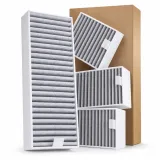
Using the supplied reference image as the sole product reference, create an Amazon A+ design preview for a soft-pack wet-wipe product. Preserve exact geometry, proportions, colors, construction, quantity, accessories, and scale. Visible details: rectangular blue flexible pack, white flip-top lid, stacked wipe sheets, single-pack quantity, and natural scale. Do not invent hidden parts or claims. Visual system: vivid royal blue, pale sky blue, white, and lime accents. Composition motifs: water-ripple circles, layered wipe sheets, rounded blue panels, and compact lifestyle frames. Alternate a wide banner, asymmetric overview, centered detail graphic, three-scene sequence, and wide closing scene. Use readable sans-serif type and mobile-safe margins. Build this official A+ module order. Keep every module independently complete; never split copy or product details. MODULE 1 — Image with text overlay — introduction Exact headline: “A Clean, Compact Pack Format” Exact supporting copy: “A considered presentation built around the product’s visible form and everyday role.” Layout: wide image-led hero; dominant complete product and large safe headline area. MODULE 2 — Single image with side text — product overview Exact headline: “Designed Around the Visible Form” Exact supporting copy: “rectangular blue flexible pack, white flip-top lid, stacked wipe sheets, single-pack quantity, and natural scale.” Layout: large three-quarter product, side text field, and two detail crops. MODULE 3 — Four-image and text — visible evidence Exact headline: “Details You Can See” Exact supporting copy: “A closer look at shape, finish, connections and included pieces.” Layout: centered product with four rounded macro callouts; show only visible facts. MODULE 4 — Multiple image and text — routine or use setting Exact headline: “A Clear Place in the Routine” Exact supporting copy: “The flip-top pack moves from closed storage to one plain wipe ready in hand.” Layout: three framed scenes with consistent product design and newly generated people or animals only when relevant. MODULE 5 — Full-width image with text overlay — closing Exact headline: “Designed to Stay Close” Exact supporting copy: “A focused final view keeps the product and visible design at the center.” Layout: wide editorial scene, strong silhouette, restrained props, safe text area. Create one vertical A+ preview at 1200px width with content-driven height, clear module boundaries, and varied compositions for independent export. Render only the exact copy above. Do not add logos, prices, promotions, QR codes, URLs, contacts, competitors, testimonials, ratings, guarantees, unverified claims, certifications, fake UI, watermarks, pseudo-text, or unrelated labels. Keep all elements natural and mobile-safe.
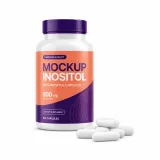
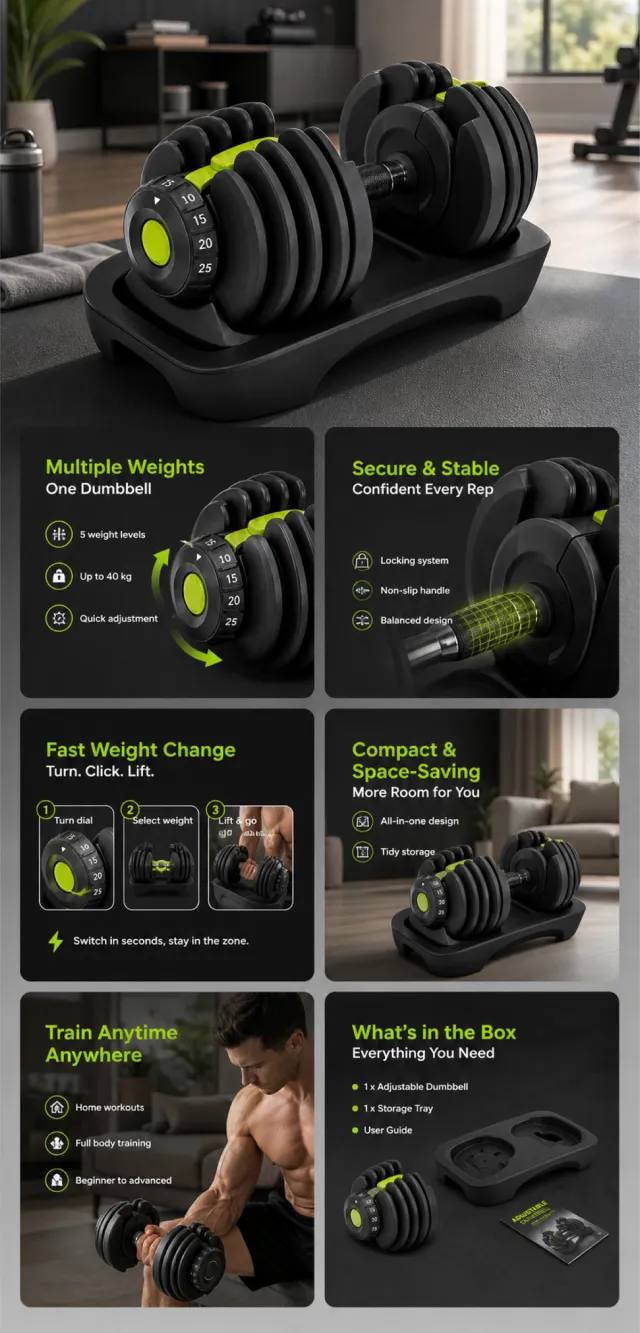
【Output Rules | Do Not Display】 Generate only one 1000×1000, 1:1 Amazon Listing secondary image. No collage images, six‑panel grids, storyboard layouts, multi‑card grids, or multiple scenes are allowed. 【Sharing Rules】 Use the provided product reference image as the sole basis for the design. The product is a wireless speaker. Strictly adhere to the reference image’s shape, structure, color, quantity, accessories, texture, and relative proportions; do not invent any components, specifications, or functions that are not shown. Employ high‑quality Amazon commercial photography and clear English infographics, with colors derived from the product, realistic lighting, and a clean layout. Maintain natural proportions for the product, human figures, hands, icons, and props—no stretching, flattening, or independent scaling is permitted. Ensure that the title, product, and labels remain fully within the safe zone, and extend the background across the entire frame to all four edges. Use “MOCKUP” exclusively for branding. Do not include outer white borders, vertical borders on the left and right, transparent fill‑ins, watermarks, contact information, social media accounts, original brand logos, platform identifiers, garbled text, distorted body parts, or unverified copy. 【Image Composition】 The title reads “SOUND, MADE SIMPLE.” Present only one complete scene: the product serves as the sole visual focal point, displayed in its best angle as confirmed by the reference image, preserving natural proportions, contours, and accessories. Use a harmonious real‑world setting or a high‑end studio backdrop. Include 2–3 brief English icon‑based selling points, limited to information visible in the reference image or reasonably confirmable; all copy must be clear, complete, and free of obstructions. Split screens, repeated product walls, and additional small cards are prohibited.

【Output Rules | Do Not Display】 Generate only one 1000×1000, 1:1 Amazon listing secondary image. No collages, six‑panel grids, multi‑card layouts, or multiple images are allowed. 【Sharing Rules】 Use the provided product reference image as the sole basis for the product. Product: quilted mattress topper. Copywriting must be in Russian; brand placeholders should use MOCKUP only. Visuals must follow high‑end commercial e‑commerce photography standards—sharp imagery, clear hierarchy, and concise, easy‑to‑read copy. The product’s appearance, structure, color, quantity, accessories, and relative proportions must match the reference image exactly. Products, people, icons, and props must maintain natural proportions. All essential information must remain within the safe area, with the background extending fully to all four edges. External white borders, vertical bars on the sides, transparent fill‑ins, watermarks, contact details, social media accounts, platform information, original branding, gibberish, irrelevant content, or unverified claims are prohibited. Headlines must not be displayed. 【Image Composition】 Create a premium square 1000×1000 listing image featuring the clean quilted mattress topper. If necessary, use entirely new scenes and fresh subjects (people or animals), ensuring natural anatomy and accurate product proportions. Exact copy separated by vertical bars: ADD A SOFT LAYER | QUILTED MATTRESS TOPPER WITH ELASTIC EDGING | VOLUMINOUS QUILTING | ELASTIC EDGE | PRECISE FIT. Keep MOCKUP legible and ensure all text remains within the safe margins. Do not include medical, safety, performance, certification, material‑origin, warranty, or other unverified claims.

Generate a效果图 for a sofa upholstery material details page. The design features a warm white background with four large, rounded-corner material information cards arranged vertically. The first card showcases a close-up of light blue memory foam with indentation, titled “Slow Rebound, Effortless Pressure Relief.” The second displays a close-up of a creamy‑white latex surface under pressure, labeled “Flexible and Adaptable.” The third presents a pale purple high‑resilience sponge pressed into shape, captioned “Elastic Support.” The fourth highlights dark gray high‑density support foam, with the title “Stable Support.” Each card is structured hierarchically with a single large character and a concise line of description, complemented by subtle status indicators; no small, distracting annotations are used. The overall aesthetic is clean, rational, and true to the materials’ textures. Output dimensions: 750 x 1500px. Avoid text misalignment, overlapping, overflow, noticeable shadows, jagged icons, meaningless small text, or web‑page borders.

【Execution Route | Do Not Display】 If the image-generation tool can be invoked multiple times: concatenate the sharing rules with A–F separately, execute six times, generating only one 1000×1000 square image each time. If only a single image can be generated at a time: first set the interface/API to a 2:3 portrait orientation (do not use Auto), then arrange A/B, C/D, and E/F into a 2-column × 3-row grid; ensure all six cells are equal in size and maintain a visual aspect ratio of 1:1. The outer canvas must not be 1:1. 【Sharing Rules】 The provided product reference image serves as the sole basis for the product. The product is a neutral woven area rug. Strictly adhere to the shape, structure, color, quantity, accessories, texture, and relative proportions shown in the reference image; do not fabricate any components, specifications, or functionalities that are not depicted. Use high-quality Amazon commercial photography and clear English infographics; color schemes should match the product, lighting must be realistic, and layout kept simple. Maintain natural proportions among the product, figures, hands, icons, and props—no stretching, flattening, or independent scaling is allowed. Titles, products, and labels must remain fully within the safe zone, with the background extending evenly to all four edges. Only MOCKUP may be used for branding. No white borders, vertical sidebars, transparent fill‑ins, watermarks, contact information, social media accounts, original brand logos, platform identifiers, garbled text, distorted body parts, or unverified copywriting are permitted. A–F are solely control markers and must not be displayed. 【A | Product Overview】Title: “PRODUCT OVERVIEW.” The hero composition fully showcases the product along with the accessories included in the reference image; accompanied by three brief English icon‑based selling points, stating only information that is visible or verifiable. 【B | Materials & Design】Title: “MATERIAL & DESIGN.” Present materials, structure, surface finish, or styling through an overall view of the product combined with 2–3 close-up details; ensure clear labeling without inventing material names. 【C | Functional Focus】Title: “FUNCTION IN FOCUS.” Demonstrate key functions within realistic usage scenarios; maintain natural proportions among figures, hands, and the product, with actions appearing genuine and information instantly understandable. 【D | Detail Close‑ups】Title: “DETAILS UP CLOSE.” Highlight 2–4 critical structural or operational areas using magnified details and short captions; do not alter the product’s structure. 【E | Everyday Use】Title: “MADE FOR REAL LIFE.” Depict usage, carrying, storage, or maintenance scenarios consistent with the product; retain only one clear theme and avoid duplication with C. 【F | Packaging Contents】Title: “WHAT’S INCLUDED.” Lay out or neatly arrange the actual products and accessories featured in the reference image, ensuring accurate quantities and relative sizes; if the contents cannot be confirmed, instead display visible specifications, dimensional relationships, or step-by-step instructions, refraining from fabricating numbers.

【Execution Route | Must Not Appear on Screen】 If the image-generation tool can be invoked multiple times: concatenate the sharing rules with A–F separately and execute six times, generating only one 1000×1000 square image each time. If only a single image can be generated at a time: first set the interface/API to a 2:3 portrait orientation and disable Auto; then generate a 2-column × 3-row grid labeled A/B, C/D, and E/F. All six cells must be equal in size, with a visual aspect ratio of 1:1. The outer canvas must not be set to 1:1. 【Sharing Rules】 The provided product reference image serves as the sole basis for the product’s appearance, structure, color, quantity, accessories, and relative proportions. The product is a light gray‑white foldable aerial photography drone kit, featuring black arms and propellers, a gimbal camera, a remote controller, and spare batteries. The visual style employs high‑end outdoor‑tech aesthetics in dark gray, ice blue, and black, with bold English typography and authentic sky and landscape photography. Products, people, animals, text, icons, and props must maintain their natural proportions; stretching or independent scaling is prohibited. All essential information must remain within the safe zone, while the background extends fully across all four edges. Only the MOCKUP logo may be used. Remove any peripheral white borders, vertical sidebars, numbering labels, watermarks, contact information, social media accounts, original brand logos, platform details, gibberish, distorted body parts, and irrelevant content. People and animals must be recreated from scratch. Copy should be concise, readable, and credible; A–F are solely control markers and must not appear on screen. 【A | Core Aerial Photography】Title: “CAPTURE MORE FROM ABOVE.” The drone flies over a valley, with the full fuselage and gimbal camera visible in the foreground, accompanied by the title and three brief functional icons. 【B | Imaging Capability】Title: “SMOOTH AERIAL IMAGING.” The gimbal camera and expansive scenery are framed together, visually demonstrating stable aerial shooting without specifying unverified resolution figures. 【C | Control Experience】Title: “CONTROL WITH CONFIDENCE.” A newly rendered adult user naturally holds the remote controller, with a clean aerial view displayed on the screen—no brand‑specific app interfaces appear. 【D | Return-to-Home Scenario】Title: “SMART RETURN SUPPORT.” A simple route map illustrates the concept of returning to the takeoff point when battery is low or communication is lost, without fabricating distance data. 【E | Environmental Adaptability】Title: “READY FOR NEW TERRAIN.” Four small scenes—grassland, rocky terrain, coastline, and snowy landscape—are depicted using the same drone at its natural scale. 【F | Kit Contents】Title: “FLY KIT INCLUDED.” The drone, remote controller, and spare batteries are laid out flat, with accessory quantities strictly adhering to the reference image.

Using the supplied reference image as the sole product reference, create an Amazon A+ design preview for a rectangular bed pillow. Preserve exact geometry, proportions, colors, construction, quantity, accessories, and scale. Visible details: white rectangular pillow, gently lofted center, contrast edge piping, one-pillow quantity, and bedding scale. Do not invent hidden parts or claims. Visual system: deep navy, bright cyan, white, and pale sky blue. Composition motifs: cloud curves, circular fill close-ups, rounded sleep-scene windows, and sweeping blue bands. Alternate a wide banner, asymmetric overview, centered detail graphic, three-scene sequence, and wide closing scene. Use readable sans-serif type and mobile-safe margins. Build this official A+ module order. Keep every module independently complete; never split copy or product details. MODULE 1 — Image with text overlay — introduction Exact headline: “A Pillow with a Clear, Airy Form” Exact supporting copy: “A considered presentation built around the product’s visible form and everyday role.” Layout: wide image-led hero; dominant complete product and large safe headline area. MODULE 2 — Single image with side text — product overview Exact headline: “Designed Around the Visible Form” Exact supporting copy: “white rectangular pillow, gently lofted center, contrast edge piping, one-pillow quantity, and bedding scale.” Layout: large three-quarter product, side text field, and two detail crops. MODULE 3 — Four-image and text — visible evidence Exact headline: “Details You Can See” Exact supporting copy: “A closer look at shape, finish, connections and included pieces.” Layout: centered product with four rounded macro callouts; show only visible facts. MODULE 4 — Multiple image and text — routine or use setting Exact headline: “A Clear Place in the Routine” Exact supporting copy: “The pillow moves from a clean product view to a made bed and a quiet rest setting.” Layout: three framed scenes with consistent product design and newly generated people or animals only when relevant. MODULE 5 — Full-width image with text overlay — closing Exact headline: “A Calm Shape for the Bedroom” Exact supporting copy: “A focused final view keeps the product and visible design at the center.” Layout: wide editorial scene, strong silhouette, restrained props, safe text area. Create one vertical A+ preview at 1200px width with content-driven height, clear module boundaries, and varied compositions for independent export. Render only the exact copy above. Do not add logos, prices, promotions, QR codes, URLs, contacts, competitors, testimonials, ratings, guarantees, unverified claims, certifications, fake UI, watermarks, pseudo-text, or unrelated labels. Keep all elements natural and mobile-safe.